Defined expansion case
List the exact later tanks, expected batch schedule, and layout allowance. This helps the supplier compare day-one capacity with staged capacity, spare piping provisions, and future control points.

Author: Site Editor Publish Time: 2026-11-16 Origin: Site
Size brewery tank cooling glycol from the real production load: tank volumes, active fermentation heat, crash-cooling targets, simultaneous events, ambient conditions, and planned expansion. Do not size a chiller, buffer tank, pump, or piping loop from tank count alone.
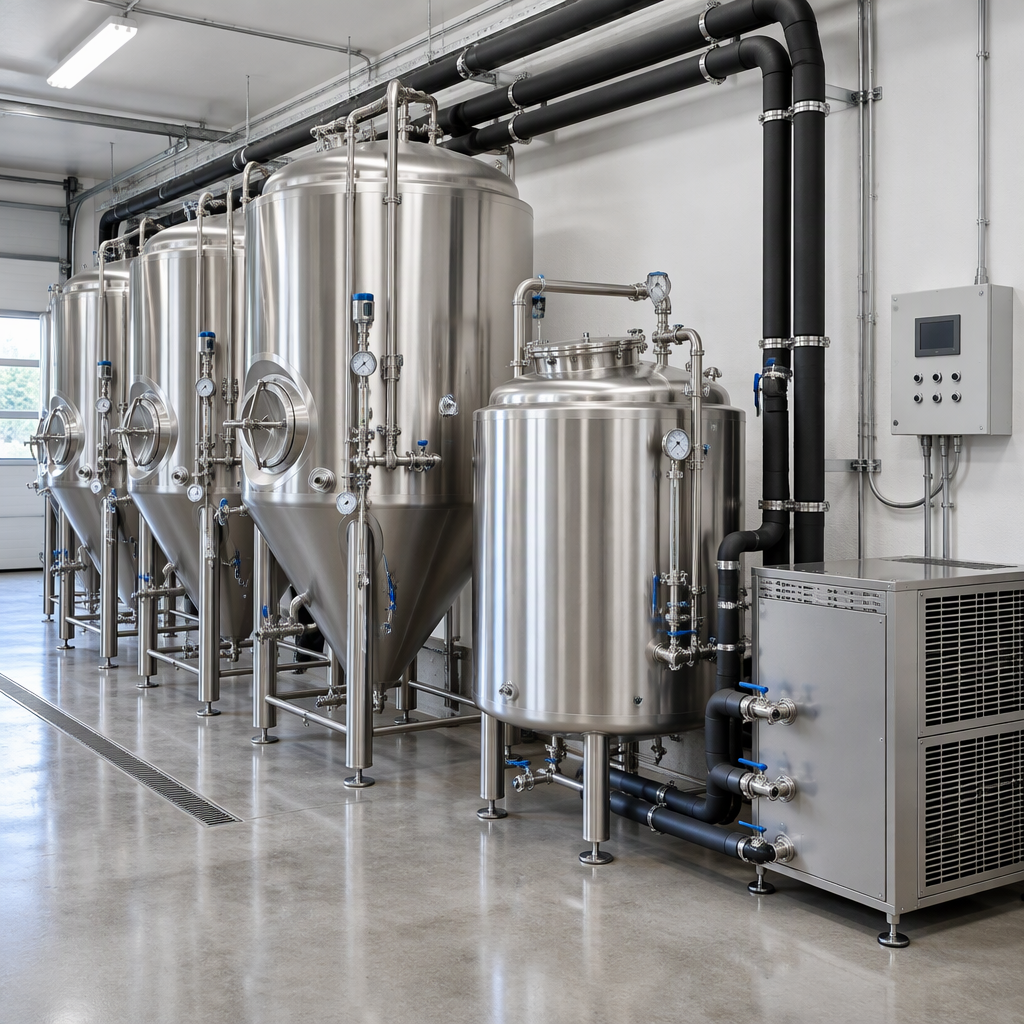
Begin by listing when and why each tank needs cooling, then group those needs into normal operating loads and realistic peak loads.
For brewery tank cooling glycol, the basic question is not “How many tanks do we own?” but “Which tanks are cooling at the same time, from what temperature, to what target, and under what room conditions?” Fermenters, unitanks, bright tanks, and crash-cooling events can create very different loads even when tank volumes look similar.
Treat glycol cooling as a brewery utility decision. Chiller capacity, buffer volume, pipe routing, control integration, and future expansion all affect whether the installed system can deliver the cooling the cellar expects.
Include every tank and process user that will draw from the glycol loop, then separate continuous temperature holding from short, high-demand cooling events.
| Load item | Why it matters for sizing | Buyer data to prepare |
|---|---|---|
| Fermenters or unitanks | They often need temperature control during fermentation and may also be used for cooling steps. | Tank volume, jacket area if known, fermentation temperature profile, batch frequency. |
| Bright beer tanks | They may add holding or finishing loads to the same glycol system. | Holding temperature, number of tanks, fill schedule, expected simultaneous operation. |
| Heat exchangers in some designs | Some brewery layouts use glycol-related cooling beyond tank jackets, so these users should not be ignored. | Process temperature in and out, flow rate, duty cycle, and whether the load overlaps with cellar cooling. |
| Cellar temperature stability | The utility plan may need to support stable cellar conditions as part of the overall cooling strategy. | Room conditions, insulation expectations, local design ambient temperature, and operating hours. |
Peak demand is controlled by simultaneous cooling events: active fermentation, crash cooling, tank holding, heat-exchanger use, and the time window in which those loads must be satisfied.
Two breweries with the same nominal tank volume can need different glycol systems if one crashes multiple fermenters at once while another staggers batches. The supplier needs the schedule, not just the cellar list.
| Peak-demand input | Decision impact | How to define it before RFQ |
|---|---|---|
| Cooling target and time window | Shorter crash-cooling time usually increases instantaneous demand. | State the start temperature, target temperature, and expected cooling duration for each tank group. |
| Simultaneous tanks | Concurrent fermentation and crash events can set the design peak. | Prepare a weekly tank-use schedule showing the worst realistic overlap. |
| Ambient conditions | Hot rooms, outdoor equipment locations, or poor ventilation can change system duty. | Give indoor and outdoor design conditions and where the chiller and piping will be installed. |
| Future expansion | Added tanks can overload a loop planned only for the first phase. | Separate day-one tanks from planned later tanks so oversizing and staged expansion can be compared. |
Professional brewery chiller design discussions include glycol, flow, piping materials, chilled-piping insulation, glycol type and concentration, testing, and tank jacket pressure drop; the Brewers Association chiller-system design seminar page is a useful checklist of topics to raise with an engineer or supplier.
A chiller nameplate is only one part of the decision; piping, insulation, pump selection, controls, and tank-jacket pressure drop determine how much cooling reaches the tanks.
Before approving a brewery glycol system, confirm the heat-transfer fluid type, concentration range, inhibitor package, material compatibility, and local requirements for possible product or personnel contact.
Ethylene glycol and propylene glycol are common secondary coolants, and inhibited glycol-based fluids are used as antifreeze and heat-transfer media. Propylene glycol is less toxic than ethylene glycol and is commonly preferred where possible human contact or regulation requires that choice, but the final selection should be confirmed with the fluid supplier and the project engineer.
Use the ASHRAE Handbook chapter on secondary coolants as a technical reference for glycol-fluid properties, then ask the fluid supplier to confirm the exact product, concentration, inhibitor maintenance, test method, and compatibility for the brewery installation.
Future tanks should be part of the sizing discussion, but they should be treated as a defined expansion case rather than an open-ended reason to buy the largest system.
List the exact later tanks, expected batch schedule, and layout allowance. This helps the supplier compare day-one capacity with staged capacity, spare piping provisions, and future control points.
Adding capacity without a real production plan can hide the actual peak load, complicate fluid volume and pumping decisions, and still fail to address the real bottleneck if piping, controls, or jacket pressure drop are limiting factors.
A practical RFQ can ask for a base configuration and an expansion-ready option. That gives procurement a clearer comparison than a single oversized number with no operating assumptions.
A universal brewery chiller tonnage chart cannot reliably size a glycol system because the real load depends on beer style, tank schedule, cooling targets, ambient conditions, loop design, and expansion plans.
This is especially important when the glycol system serves more than one function. A brewery that cools fermenters, bright tanks, and other loop users through the same utility must check whether the peak occurs during production, crash cooling, transfer, packaging preparation, cleaning-related process steps, or a future expansion phase.
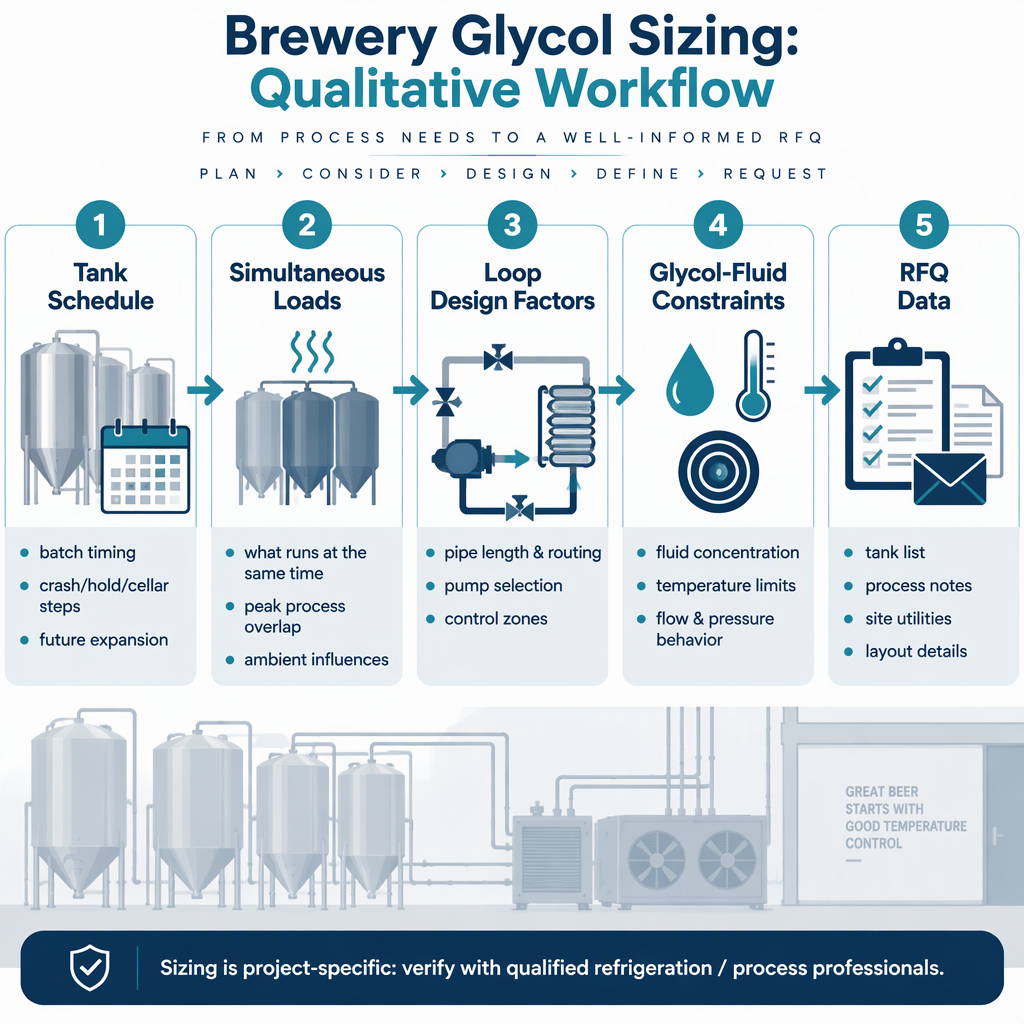
Before asking for a glycol-cooling quote, prepare a tank schedule, temperature targets, peak-event assumptions, layout constraints, fluid requirements, utilities, and expansion plan.
The right brewery glycol-cooling size comes from a documented load case, not from a single tank volume or generic chiller label.
For a dependable RFQ, define the tank schedule, simultaneous peak load, loop design constraints, glycol-fluid limits, cleaning and layout needs, and expansion case. Then ask suppliers to explain their assumptions so engineering, brewing, and procurement teams can compare proposals on the same basis.
These common questions help brewery teams turn glycol-cooling principles into RFQ-ready decisions.
No. Tank volume is only one input. The sizing discussion should also include beer style, cooling target, crash-cooling duration, ambient conditions, simultaneous tanks, and future expansion.
Peak demand usually comes from overlapping cooling events, such as active fermentation control, crash cooling, tank holding, and other loop users operating within the same time window.
Yes, if they connect to the same glycol utility. Bright beer tanks can add holding or finishing loads, so their number, temperature target, and operating schedule should be listed.
Flow, chilled-piping insulation, piping materials, and tank-jacket pressure drop are recognized chiller-system design topics for brewers because they affect how cooling is delivered to the tanks.
Propylene glycol is less toxic than ethylene glycol and is commonly preferred where possible human contact or regulation requires it, but the final fluid choice should be confirmed against the project conditions, supplier guidance, and local requirements.
There is no single universal percentage for every brewery. Confirm the required freeze protection, operating temperature, manufacturer guidance, and inhibitor maintenance; ASHRAE also cautions against going below 25% by volume in use or above 60% glycol.
Ask the fluid and component suppliers to confirm compatibility with all wetted materials, and avoid galvanized metals with glycol-based fluids because they can react with corrosion inhibitors.


