Home » News » Two-Vessel vs. Three-Vessel Brewhouses: Which Fits Your Brewing Schedule?

Two-Vessel vs. Three-Vessel Brewhouses: Which Fits Your Brewing Schedule?

Author: Site Editor     Publish Time: 2026-11-22      Origin: Site

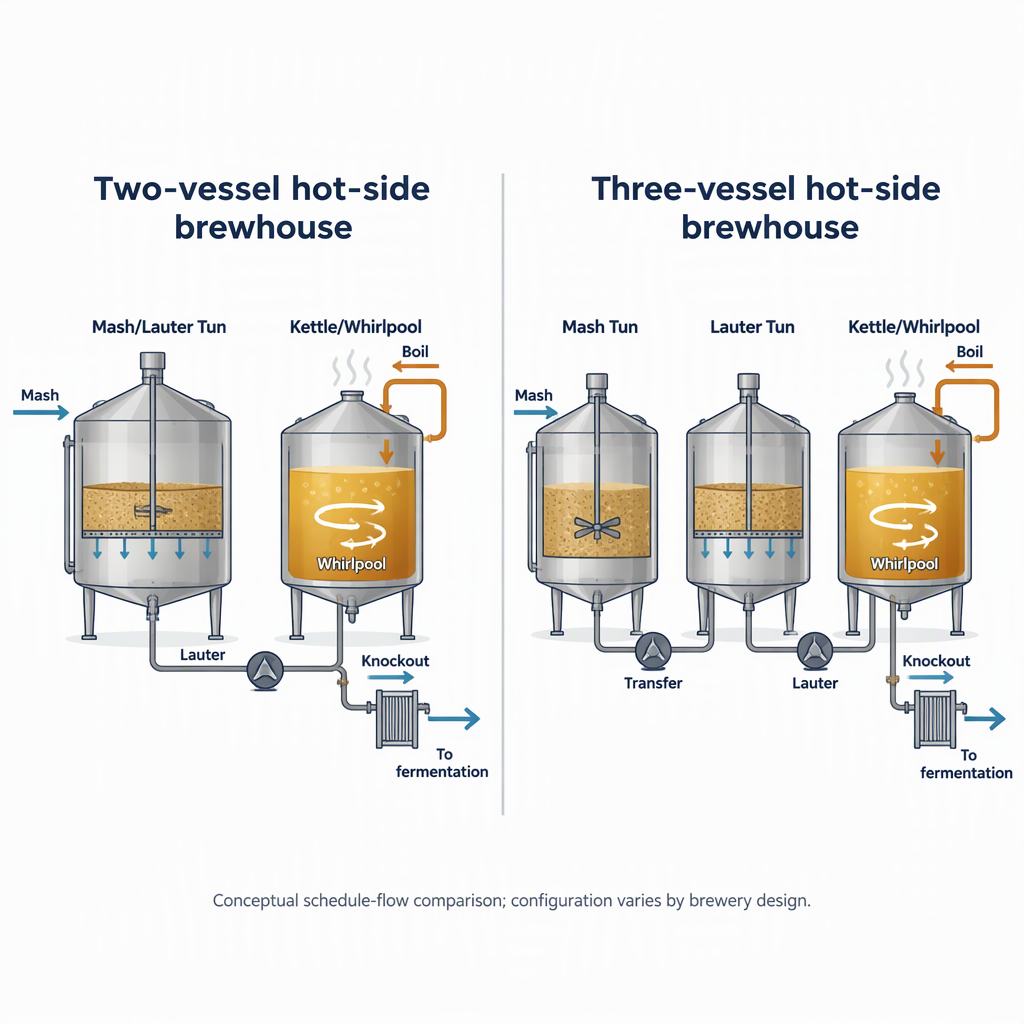
Neutral brewery layout illustration comparing two-vessel and three-vessel hot-side configurations

What changes between two-vessel and three-vessel brewhouses?

The practical difference is whether core hot-side steps share vessels or are separated into more dedicated tanks.

Two-vessel configuration

A common two-vessel arrangement combines mash and lauter functions in one vessel and kettle and whirlpool functions in another, so the schedule depends on how quickly each shared vessel is free for the next batch.

This layout usually belongs in the shortlist when available space, initial investment, staffing simplicity, and near-term production needs matter more than maximum hot-side overlap.

Three-vessel configuration

A three-vessel arrangement separates more of the core process, which can let one batch move through lautering while the next mash begins, depending on the brewery’s recipe, utilities, and operating method.

That extra separation also adds equipment footprint, capital cost, cleaning points, and coordination requirements, so it should solve a real scheduling constraint rather than simply look more complete on a layout drawing.

Which layout fits your brewing schedule?

Start with the brew-day sequence from mash-in to knockout, then identify where the next batch waits for a vessel, operator, utility, or cleaning step.

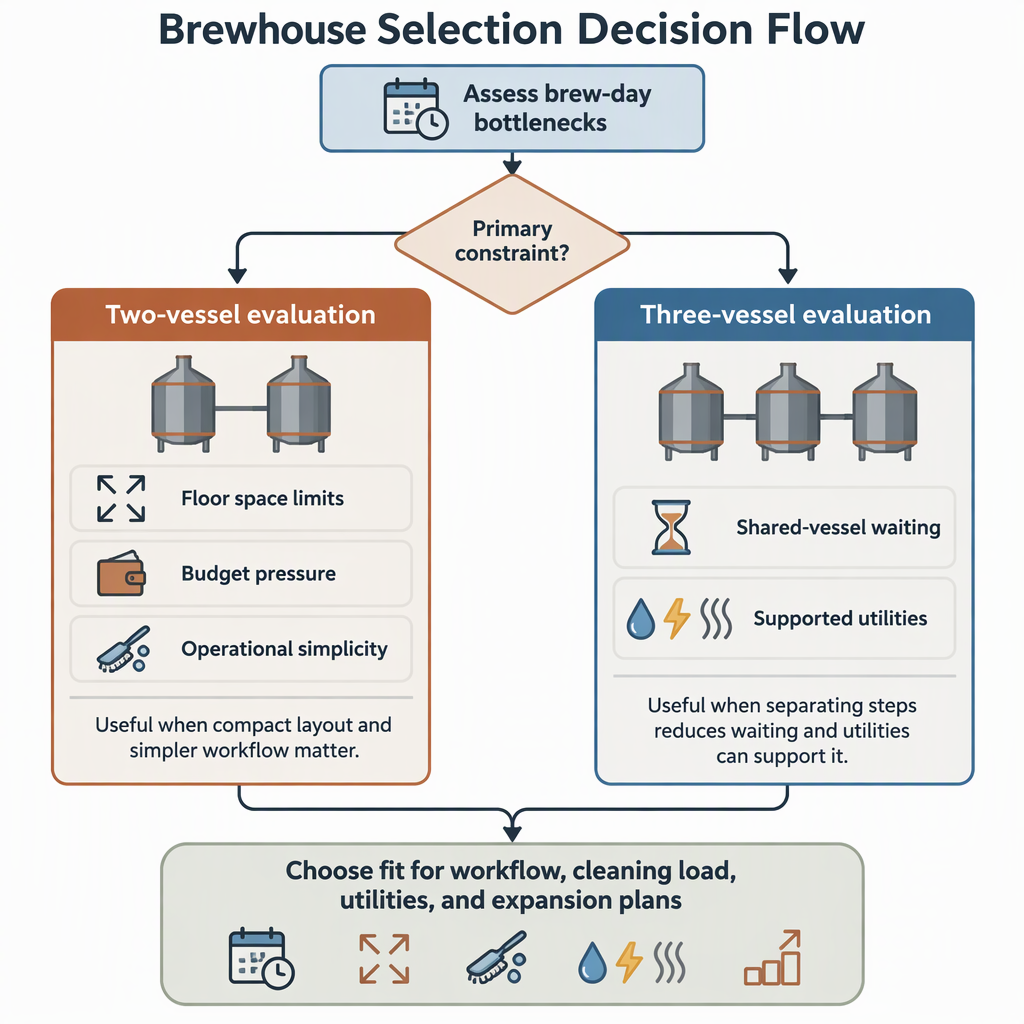
Decision path showing when schedule overlap favors three vessels and when space or simplicity favors two vessels

The Brewers Association brewhouse resource hub frames brewhouse guidance around the practical steps of brew day, so the comparison should follow the process rather than vessel count alone.

Schedule question Two-vessel implication Three-vessel implication
Does the next mash wait because the mash/lauter vessel is occupied? The shared vessel can become the pacing item. Separated process steps may allow more overlap.
Is kettle/whirlpool sharing limiting knockout timing? The kettle/whirlpool combination can require careful sequencing. More separation may reduce shared-vessel waiting, depending on configuration.
Are labor, utilities, and cleaning already the bottleneck? A simpler layout may be easier to run consistently. Extra vessels may not help unless supporting resources are available.

When does a two-vessel brewhouse make more sense?

A two-vessel brewhouse makes more sense when your real constraint is space, starting investment, staffing simplicity, or moderate batch frequency rather than maximum batch overlap.

Buyer condition Why two vessels may fit Check before deciding
Current and near-term production needs are modest. The layout can match the present brewing plan without paying for unused vessel separation. Map the weekly brew calendar and the expected growth horizon.
Floor space is tight. Fewer vessels generally reduce the hot-side footprint compared with a three-vessel layout. Reserve practical access space for operation, cleaning, and future expansion if growth is likely.
The team wants a simpler operating pattern. Lower operating complexity can be valuable when staffing or training capacity is limited. Review cleaning, hot-liquid movement, pump use, and platform access before approving the layout.

When is a three-vessel brewhouse worth the added complexity?

A three-vessel brewhouse is worth evaluating when shared-vessel waiting is the bottleneck and the brewery can support the added footprint, utilities, cleaning work, and coordination.

Buyer condition Why three vessels may fit Boundary to confirm
The next batch frequently waits for lautering or kettle availability. Separating more process steps can allow partial overlap between batches. Confirm that the expected batch turnaround justifies the added investment.
The brewery has near-term growth needs. A configuration with more separation may support a busier schedule when the rest of the site is ready. Check whether building services and utilities can support future demand.
Operators can manage more simultaneous process activity. Overlap only helps when the team can coordinate vessels, transfers, and cleaning without creating new delays. Include safety practices for hot surfaces, hot liquids, pumps, and chemical handling in the operating plan.

What cost components should procurement compare?

Compare total installed and operated cost categories, not only the purchase price of the vessels.

Cost component Why it matters How to compare fairly
Initial investment Vessel count, controls, platforms, valves, piping, and accessories affect the starting budget. Ask each supplier to quote the same scope and exclusions.
Building and layout work Available space and expansion planning affect the practical cost of either choice. Compare drawings against the same room dimensions, access routes, and drainage concept.
Labor and operating complexity Batch turnaround and labor cost are part of the selection framework. Model the same brew schedule, operator coverage, and cleaning windows.
Safety and cleaning provisions Hot liquids, cleaning chemicals, pumps, and elevated platforms can affect procedures and equipment layout. Include safe access, PPE expectations, chemical storage, and transfer routes in the review.

What should be measured on site before selection?

Measure the brewery as an operating system: room, access, utilities, drainage, cleaning routes, and future expansion space should be checked before the vessel count is finalized.

  • Room dimensions, ceiling height, door openings, and service access around vessels.
  • Planned batch frequency, batch size, brew-day timing, and expected near-term production growth.
  • Utility availability for the selected heating method, electrical load, water supply, compressed air, cooling, and drainage.
  • Safe walking routes around hot surfaces, hot liquids, pumps, hoses, elevated platforms, and cleaning-chemical handling points.
  • Space that should remain available if the brewery may add vessels or supporting equipment later.

How do cleaning, safety, and utilities affect the decision?

Cleaning, safety, and utilities can decide whether the theoretical schedule benefit of an added vessel is practical in daily operation.

  • Check cleaning-chemical handling and storage before choosing a layout that adds more cleaning points.
  • Review hot-liquid transfer paths, pump locations, hose movement, and boiling or whirlpooling work areas.
  • Confirm platform and access needs where operators must observe, sample, connect hoses, or clean around vessels.
  • For any permitted manual access to pumps, hoses, ports, or cleaning areas on powered equipment, switch off and disconnect the relevant power source before access, then follow the equipment manual and site lockout rules.
  • Include periodic hazard analysis for the actual brewery environment rather than copying another facility’s layout.

How should you plan for future expansion?

If you may add capacity later, plan the building, utilities, and access routes before choosing the first brewhouse layout.

  1. Define the current brew schedule and the realistic near-term production target.
  2. Identify which step limits turnaround: vessel availability, operators, heating, cooling, transfer, cleaning, or cellar capacity.
  3. Reserve floor area, drainage, service clearances, and utility capacity for the expansion path you are most likely to use.
  4. Ask suppliers to show how the initial layout would change if more vessel separation is added later.
  • Do not block future vessel placement with fixed drains, platforms, walls, or utility runs.
  • Compare the cost of buying the extra separation now with the disruption of changing the room later.
  • Keep the decision tied to production needs instead of assuming every brewery should start with the same vessel count.

Conclusion: choose the vessel count that removes your real bottleneck

The right choice is the vessel count that removes the constraint you can prove in your own schedule, site, and operating plan.

  • Choose two vessels when shared-vessel timing is acceptable and simplicity, space, and starting investment dominate.
  • Evaluate three vessels when overlapping process steps will relieve a real batch-turnaround constraint.
  • Before purchase, test the layout against cleaning, hot-liquid transfer, utilities, access, and safety practices.

FAQs

These questions help operators and procurement teams turn the comparison into a practical specification discussion.

Is a two-vessel brewhouse a poor choice for a growing brewery?

No. It can fit a growing brewery when the current schedule, space, and investment boundary make sense and future building and utility needs are planned early.

Is a three-vessel brewhouse always faster?

No. It can allow more process overlap, but the benefit depends on the actual bottleneck, supporting utilities, operator coverage, transfer timing, and cleaning workflow.

How should procurement compare two quotes fairly?

Ask suppliers to price the same scope, including vessels, controls, platforms, piping, valves, access, utilities interface, cleaning provisions, and any future expansion assumptions.

What should be checked before finalizing vessel count?

Check the brew calendar, room dimensions, access clearances, utility capacity, drainage, cleaning routes, and the space needed for near-term production growth.

Can cleaning workflow change the best choice?

Yes. A layout that looks efficient on the brew schedule can lose value if cleaning chemicals, hot-liquid movement, pumps, or access points create avoidable delays or hazards.

If floor space is limited, should the brewery automatically choose two vessels?

Not automatically. Limited space favors a simpler layout, but the final decision should still test whether shared-vessel waiting will prevent the required weekly production schedule.

Can a brewery start with two vessels and expand later?

It may be possible when the original building layout, utilities, drains, access routes, and supplier design allow for future additions without major rework.

Ready to Build Your Brewery with a Trusted Partner?

Don't navigate the world of brewery manufacturing alone. Let my team of experienced engineers provide you with a no-obligation quote and a preliminary design for your project.
Contact us
​Jinan Cassman Machinery Co., Ltd. is mainly engaged in beer equipment, whiskey distillery equipment, biological fermentation, and environmental protection equipment, among others.​

Quick Links

Product Category

Contact Us

Email: inquiry@cassmanbrew.com

Tel: 0086 531 88822515

Mobile/Whatsapp/Wechat: +86 18560016154

Factory Address: No.3-1, Weili Industrial Park, Qiliu Road,Qihe County, Dezhou City. Shandong. China.

 
Copyright © 2025 Jinan Cassman Machinery Co., Ltd.All Rights Reserved. Sitemap