Who This Guide Is For
If you’re evaluating brewhouse configurations, you’re likely balancing production volume, recipe complexity, budget, and infrastructure constraints. This guide is written for two key roles:
Brewers: You care about consistency, cleanability, oxygen control, and how easily the system handles high-wheat or high-gravity recipes.
Procurement/Operations Managers: You need quantifiable specs, comparable vendor data, clear acceptance criteria, and a defensible TCO model.
We’ll cut through marketing fluff and focus on what actually moves the needle in real-world operations.
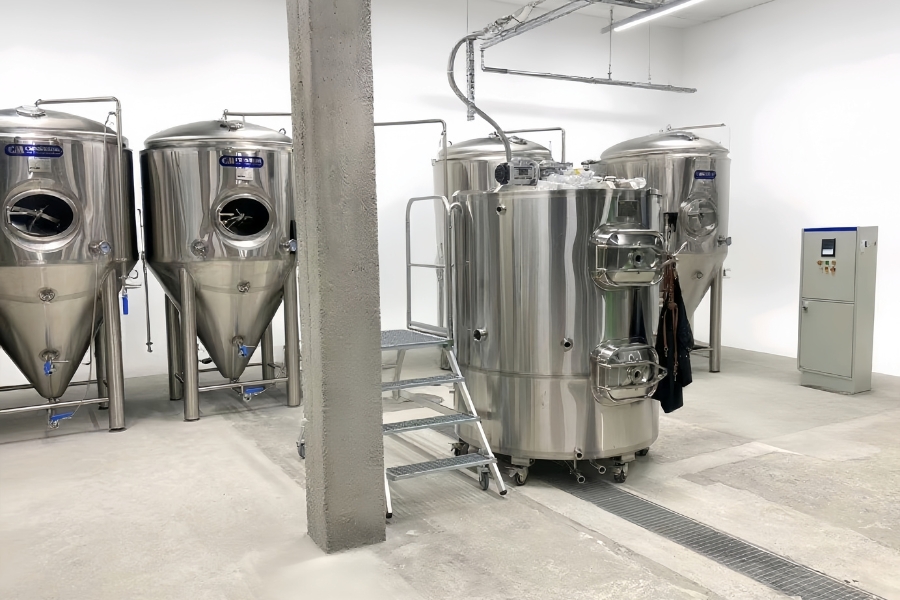
1. What’s Actually in Each System? (No Jargon, Just Clarity)
Before comparing performance, agree on what “2/3/4-vessel” really means. Configurations vary by vendor—here’s the industry-standard baseline:
Configuration | Typical Vessels | Key Characteristics |
Two-vessel | Mash/Lauter combo + Kettle/Whirlpool combo | Compact, lowest CAPEX, but sequential operations limit throughput. |
Three-vessel | Dedicated Mash/Lauter + Kettle + Whirlpool (or Mash + Lauter + Kettle/Whirlpool) | Enables overlapping mashing, lautering, and boiling—big throughput jump. |
Four-vessel | Mash Mixer + Lauter Tun + Kettle + Whirlpool | Full parallelism. Ideal for high-SKU, high-duty cycles with minimal downtime. |
Pro Tip: Ask vendors for a P&ID (Piping & Instrumentation Diagram) early. Many “3-vessel” systems still combine functions in practice.
2. Real-World Throughput: Batches Per Day ≠ Theoretical Capacity
Your bottleneck isn’t always the brewhouse—it’s lauter time, steam availability, or CIP changeovers. Assuming standard recipes and competent operation:
Two-vessel: 2–3 batches/day
Three-vessel: 3–5 batches/day
Four-vessel: 5–8 batches/day
But don’t overspec the hot side if your fermentation capacity is less than 6–10× your brewhouse volume. You’ll create a logjam downstream.
Watch out for: Long lautering on high-oat grists, slow heat-up rates, or insufficient glycol headroom during concurrent whirlpool chilling.
3. Quality & Efficiency: Vessel Count ≠ Extract Yield
More vessels help with parallelism, but extract efficiency and consistency depend on:
Lauter tun design: False bottom slot size (0.18–0.22 mm typical), sparge arm distribution, and underlet flow control.
Thermal management: Dedicated kettles allow precise boil-off control (8–10% typical); dedicated whirlpools improve trub cone formation and reduce hot-side oxygen pickup.
Recipe flexibility: High-gravity or >30% adjunct grists run smoother with separate mash/lauter to avoid stuck sparges.
Data point: In our field audits, well-designed 3-vessel systems often match 4-vessel extract yields—when lauter control logic is robust.
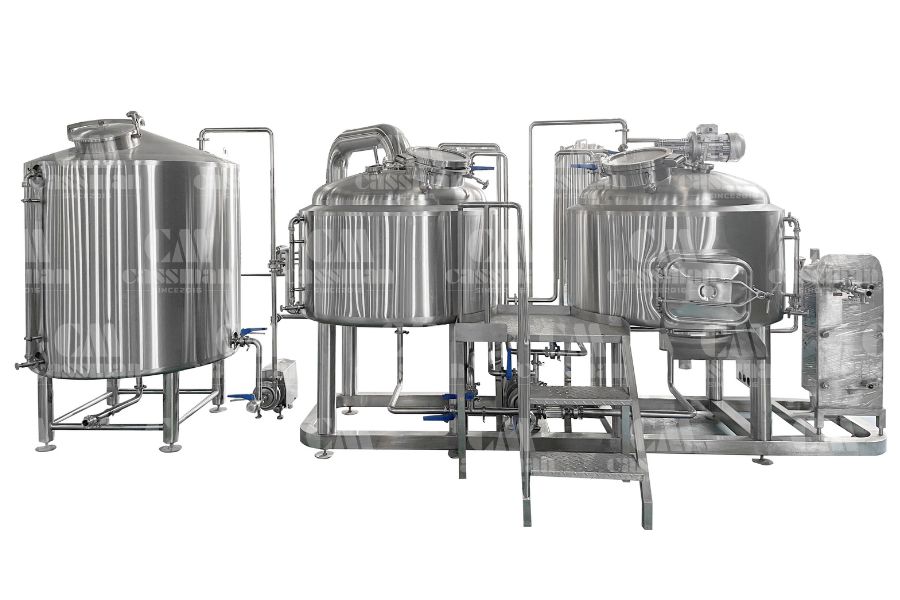
4. Hidden Bottlenecks: Utilities, Layout & Safety
Your brewhouse won’t perform if infrastructure lags:
Heat source:
Steam: Fast, even heating—ideal for 3/4-vessel. Requires boiler permit, stack, and makeup air.
Electric: Simpler install but demands 480V 3-phase; verify panel capacity before ordering.
Direct fire: Lower hardware cost, but poor thermal efficiency and ventilation challenges.
Cooling: Size your glycol loop for worst-case concurrent loads (e.g., whirlpool + fermenter crash) with 20–30% headroom.
Floors & drainage: Continuous 1–2% slope to trench drains; chemical/thermal-resistant epoxy; vapor exhaust above kettle/whirlpool; CO₂ monitors in confined spaces.
5. Automation: Buy Repeatability, Not Buzzwords
A “smart” system should deliver consistent batches, not just flashy HMIs. Minimum viable scope:
Sequenced temperature ramps, valve interlocks, pump logic
Recipe storage with version control
Remote diagnostics + manual override
Critical sensors: Temp, flow, pressure, SG/density, DO (post-whirlpool), CIP conductivity
FAT/SAT must-test: Heat-up rate (e.g., 1.2°C/min), lauter time window (±5 min), whirlpool clarity (<50 NTU runoff), CIP spray coverage (dye test).
6. Total Cost of Ownership (TCO): Beyond the Sticker Price
System | CAPEX | Labor/HL | Downtime Risk | Best Fit |
Two-vessel | $ | Higher (frequent changeovers) | Medium | Taproom-first, <500 HL/yr |
Three-vessel | $$ | Balanced | Low-Medium | Growing micros, 500–2,000 HL/yr |
Four-vessel | $$$ | Lowest at scale | Low | High-volume, multi-brand, >2,000 HL/yr |
TCO includes:
Equipment + installation (15–25% of equipment cost)
Energy (steam/electric), water, caustic/acid
Maintenance, spare parts, calibration
QA instrumentation & validation labor
When to level up: If you consistently run ≥4 batches/day with varied SKUs, 3-vessel is the sweet spot—and design it to accept a future dedicated whirlpool.
7. Decision Framework: Match System to Your Reality
Ask these three questions:
Volume: What’s your target monthly HL? → Back-calculate required daily batches.
Mix: Do you brew high-wheat, sour, or high-gravity beers? → These stress combo vessels.
Team: Small crew? → Prioritize segmented CIP and automation to reduce labor variance.
️ Still unsure? Share your:
Target monthly volume
Average batch size
Recipe mix (% adjuncts, ABV range)
Heat source preference (steam/electric)
Available power, floor space, ceiling height
I’ll send you a vendor-neutral spec sheet, takt-time Gantt, and FAT/SAT checklist for your RFP.
8. At-a-Glance Comparison
System | Daily Batches | Strengths | Trade-offs | Ideal For |
Two-vessel | 2–3 | Low CAPEX, small footprint | Sequential ops, more cleaning | Taproom, pilot, budget builds |
Three-vessel | 3–5 | Throughput + flexibility | Higher utilities, CAPEX | Scaling micros, multi-SKU |
Four-vessel | 5–8 | Max uptime, repeatability | Complex install, highest cost | Production breweries, contract brewing |
Key takeaway: If future growth is uncertain, start with a 3-vessel system designed for upgrade—reserve space, nozzles, and utility stubs for a future dedicated whirlpool or mash tank.
9. Installation & Validation: Don’t Skip the Details
Pre-install: Confirm steam pressure, 3-phase amperage, glycol GPM, drain slope, and ceiling crane clearance.
FAT (Factory Acceptance Test): Test jacket pressure, heat curves, valve sequencing, CIP spray balls.
SAT (Site Acceptance Test): Validate lauter time, whirlpool knockout temp (<90°C in 20 min), CIP return conductivity.
Pro move: Write your FAT/SAT protocols before signing the PO. Tie final payment to successful validation.
Frequently Asked Questions (FAQ)
Does a four-vessel system always give higher extract?
No. Extract depends more on mash schedule, lauter design, and operator discipline than vessel count. A poorly controlled 4-vessel can underperform a well-tuned 3-vessel.
Can I start with two vessels and upgrade later?
Yes—but only if you plan ahead. Reserve floor space, utility connections (steam, glycol, power), and control I/O for a future dedicated whirlpool or lauter tun.
Steam vs. electric for a three-vessel system?
Steam offers faster, more uniform heating and better scalability. Electric works if you have robust 3-phase power and accept slower ramp rates. Avoid direct fire for anything beyond nano-scale.
Final Thoughts
Choosing a brewhouse isn’t about “more vessels = better.” It’s about matching configuration to your production rhythm, recipe demands, and team size.
For most growing breweries, a well-specified three-vessel system delivers the best balance of throughput, flexibility, and TCO—especially when designed with future expansion in mind.
Let me know if you’d like the structured data (JSON-LD) for this article, or a printable PDF checklist version for your procurement team.

