

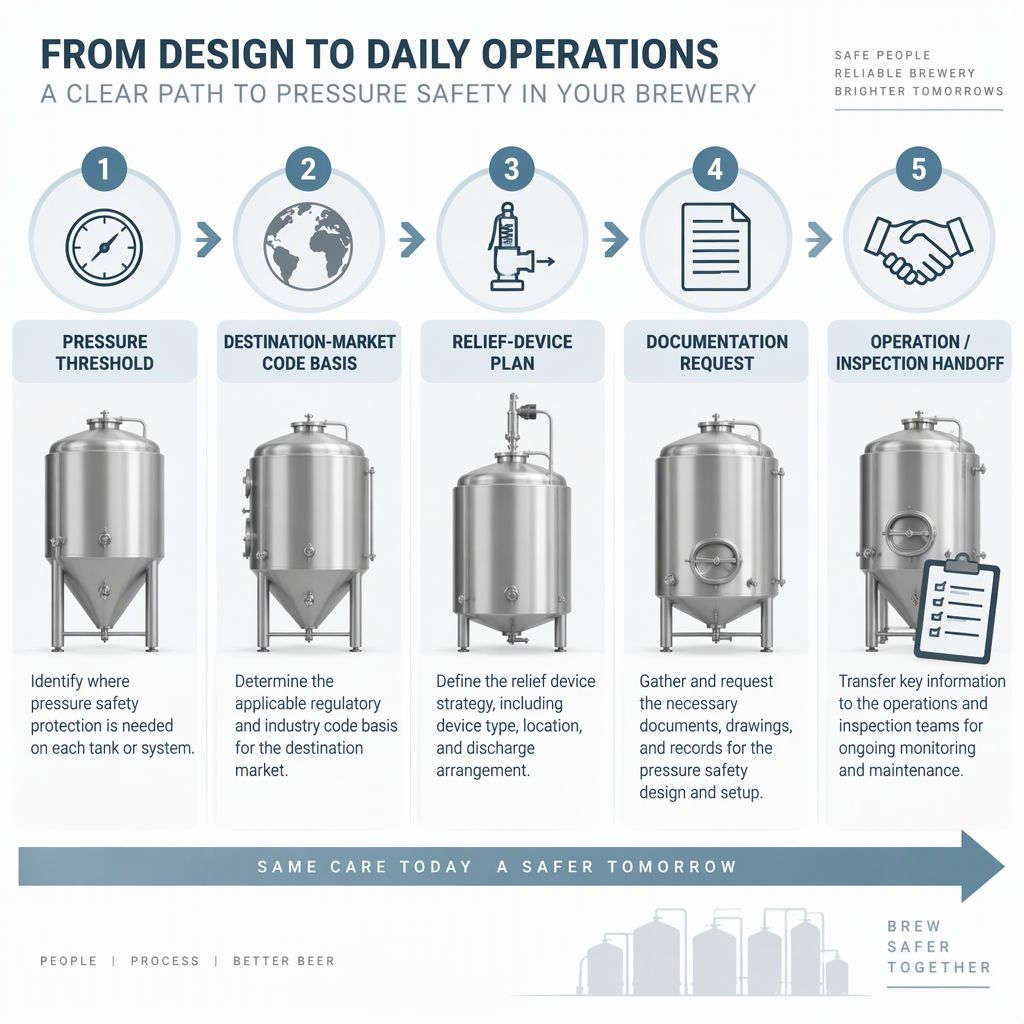
Start with the pressure threshold, not the tank name
A brewery tank specification should flag any process expected to operate above 15 psi for pressure-rated-vessel review and local jurisdiction confirmation.
The Brewers Association describes an ASME-rated tank in brewery use as a brewing process tank where working pressures exceed 15 psi and recommends ASME-rated tanks for processes requiring pressure above that level.
ASME’s 2025 BPVC Section VIII Division 1 page states that the division covers requirements for pressure vessels operating at internal or external pressures exceeding 15 psig, including design, fabrication, inspection, testing and certification scope.
For procurement, this means the RFQ should not rely on a category name such as fermenter, brite tank or serving tank. It should state maximum intended pressure, vacuum or external-pressure conditions if relevant, carbonation or transfer use, cleaning and gas-utility interfaces, and the destination where the vessel will be installed.
Match the code basis to the destination market
The specification should name the destination market and ask which pressure-equipment rule, code edition and local authority acceptance path applies before the tank is ordered.
| Specification check | What to ask for | Why it matters |
|---|---|---|
| Brewery pressure threshold | State the intended operating pressure and ask whether the application requires an ASME-rated vessel and local-jurisdiction review. | Brewery guidance connects processes above 15 psi with ASME-rated-vessel review and tells breweries to check the local jurisdiction. |
| ASME pressure-vessel basis | Ask the supplier to identify the code edition, certification-mark status and inspection/testing deliverables that apply to the proposed vessel. | ASME BPVC Section VIII Division 1 covers pressure-vessel design, fabrication, inspection, testing and certification for vessels above 15 psig within its scope. |
| EU destination-market basis | For EU projects, ask how the proposed equipment is classified and assessed under the applicable PED route. | The European Commission states that the Pressure Equipment Directive 2014/68/EU applies to stationary pressure equipment with maximum allowable pressure greater than 0.5 bar. |
For EU-bound projects, use the European Commission’s Pressure Equipment Directive page as a high-level destination-market check, then confirm the detailed conformity assessment route with qualified engineering and the relevant authority.
Specify pressure relief as a safety system
Pressure relief should be specified as part of the vessel’s safety system, with device selection, documentation, inspection responsibility and in-service maintenance clearly assigned.
- Ask whether pressure relief devices are required for the proposed pressure equipment and which recognized in-service inspection or maintenance rules will be followed.
- Request relief-device data sheets, set-pressure information, materials of construction, connection details and protected equipment identification.
- Ask how the relief path avoids blockage during brewery operation, cleaning, carbonation, transfer and utility changes.
- Define who is responsible for installation acceptance, inspection records, tag control and future replacement or recertification scheduling.
The National Board describes the NBIC as covering installation, inspection, repair and alteration of in-service pressure equipment, and states that Part 4 addresses pressure relief devices.
Do not treat a relief valve as a substitute for a complete pressure-safety specification. The vessel rating, operating controls, gas supply, CIP connections, blocked-outlet scenarios and operator instructions should all be checked together.
Ask for verifiable documents, not broad safety claims
Procurement should request specific pressure-safety documents and acceptance criteria instead of accepting general statements that a tank is safe or suitable.
- If ASME BPVC Section VIII Division 1 applies, ask for the code edition, applicable certification-mark status and inspection/testing documentation named in the proposal.
- For in-service obligations, ask how installation, inspection, repair, alteration and pressure-relief-device records will be handed over to the brewery team.
- Ask for the nameplate data, design pressure, maximum allowable working pressure if applicable, design temperature range, relief-device documentation and pressure-test records that correspond to the ordered vessel.
- Ask the supplier to identify any operating restrictions for carbonation, transfer, CIP, steam or compressed-gas utilities, and layout constraints around vents and relief discharge.
The official ASME page for BPVC Section VIII Division 1, 2025 edition identifies design, fabrication, inspection, testing and certification as part of its pressure-vessel scope.
The National Board’s NBIC page places installation, inspection, repair, alteration and pressure relief devices in the in-service pressure-equipment framework.
Separate product claims, test files, use limits and rules
A strong brewery tank specification separates what the product is claimed to be, what has been tested or inspected, how the brewery may use it and which destination rules apply.
| Item in the file | Buyer question | How to use it in selection |
|---|---|---|
| Product claim | What pressure, service and tank configuration is the supplier offering? | Match the claim to the exact tank, batch size, process duty, utilities and installation destination. |
| Code or certification statement | Which code edition, certification mark and scope are being stated? | Use it only for the vessel and scope it names; do not extend it to another tank type or market. |
| Test or inspection record | Which serial number, test pressure, date and inspector or authorized body does it identify? | Keep it with the receiving file and compare it with the nameplate and purchase specification. |
| Operating instruction | What pressure, temperature, cleaning and gas-utility limits must operators follow? | Convert limits into SOPs, training and layout controls before commissioning. |
| Destination-market rule | Which authority, directive or local rule governs installation or market access? | Confirm the applicable route for the destination instead of assuming one global rule applies everywhere. |
Do not rely on retrofit as the safety plan
If the intended process may require an ASME-rated tank, specify that requirement before purchase rather than planning to convert a non-rated vessel later.
The Brewers Association guidance supports deciding pressure duty before purchase: processes expected to operate above 15 psi should trigger ASME-rated-vessel review and local jurisdiction confirmation.
For brewery planning, the safest commercial habit is to classify the pressure duty during layout and process design. Carbonation, pressure transfer, brite-beer service, gas manifolds, cleaning connections and future recipe changes can all affect whether a tank will be used above low-pressure assumptions.
Define the handoff from purchase to operation
The purchase file should become the brewery’s operating boundary: operators need the approved pressure limits, relief-device information, inspection responsibilities and maintenance handoff before the tank enters service.
- Confirm the pressure duty and local jurisdiction requirements before approving the tank specification.
- Receive the pressure-vessel documentation that corresponds to the applicable code basis, inspection and testing scope.
- Assign in-service inspection, repair, alteration and pressure-relief-device responsibilities before commissioning.
- Translate pressure limits into brewery SOPs for carbonation, transfers, CIP, gas supply, valve lineup and batch scheduling.
- Before any manual access, internal inspection or cleaning work, depressurize and isolate the tank from gas, liquid, steam and chemical utilities; for powered pumps, mixers or control equipment, switch off and disconnect the relevant power source before access, then follow the model manual’s permitted procedure.
Use an RFQ checklist that procurement can enforce
A practical RFQ turns pressure safety into yes-or-no deliverables: pressure basis, destination rule, relief plan, documents, operating limits and responsibility for acceptance.
- State the intended working pressure and ask whether the application exceeds the 15 psi brewery guidance threshold for pressure-rated-vessel review.
- Name the requested pressure-vessel code basis and ask for the applicable edition, inspection, testing and certification-mark information.
- For EU destinations, ask how the equipment is evaluated against the Pressure Equipment Directive threshold and conformity assessment framework.
- Require a relief-device plan, including protected equipment, device documentation, installation responsibility and in-service inspection handoff.
- Require tank-specific nameplate data, drawings, pressure limits, utility connections, CIP assumptions, venting or discharge clearances and restrictions that affect brewery layout.
- Require the supplier to identify exclusions, destination approvals still needed and any information the brewery must provide before final design approval.
Conclusion
The best brewery tank pressure-safety specification is jurisdiction-aware, document-driven and practical for operators: define the pressure duty first, match the code basis to the destination, require relief-device and inspection records, and turn all operating limits into brewery procedures before commissioning.
FAQs about brewery tank pressure safety
These questions help brewery operators, brewing-process teams and engineering procurement turn pressure-safety requirements into purchase and operating checks.
What are the most common pressure-safety FAQs for brewery tank specifications?
The common questions are whether the process exceeds the brewery pressure threshold, which destination rule applies, what relief devices are required, which documents must be delivered, and how operating limits transfer into brewery SOPs.
Does every brewery tank above 15 psi need extra review?
Yes. Brewery guidance identifies working pressures above 15 psi as the point where ASME-rated-vessel review and local jurisdiction confirmation become important.
Is ASME the same as local approval?
No. Brewery guidance tells breweries to check local jurisdiction, so the RFQ should ask both for the code basis and for the destination authority requirements that apply to the installation.
What changes when tanks are installed in the EU?
EU-bound stationary pressure equipment should be checked against the Pressure Equipment Directive 2014/68/EU when maximum allowable pressure is greater than 0.5 bar.
Is a relief valve alone enough for pressure safety?
No. Relief devices are part of a wider safety file that should also cover installation, inspection, repair, alteration and in-service responsibilities.
Which documents should be requested before ordering?
Ask for tank-specific design pressure information, applicable code or directive basis, inspection and testing records, relief-device documentation, operating limits, drawings and any destination approvals still required.
Can a non-rated tank be converted later if the process changes?
Do not use a future retrofit assumption as the purchase strategy. If the process may operate above 15 psi, specify the pressure-rated-vessel requirement and confirm the local jurisdiction before ordering.


