
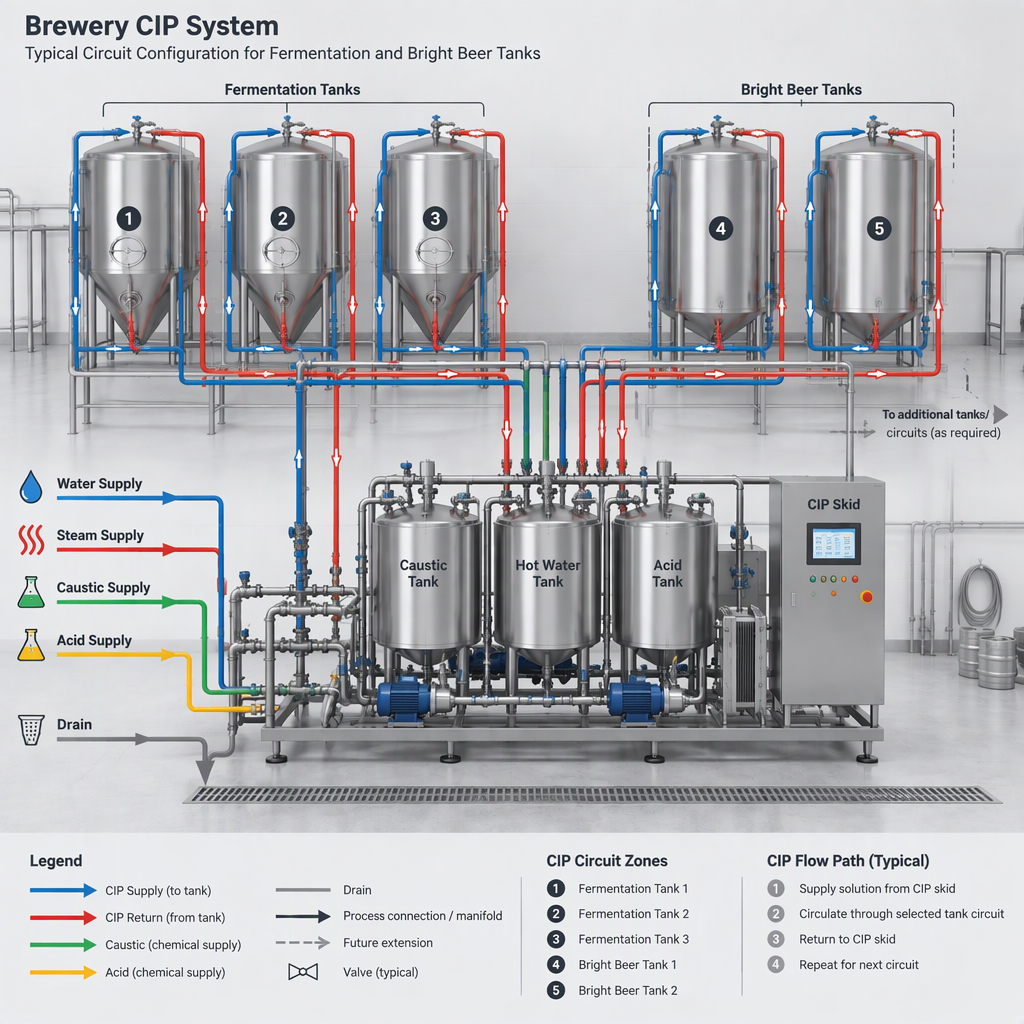
Map the Brewery Circuits Before Sizing Equipment
Start brewery CIP system sizing by drawing the cleaning boundary: every vessel, process line, valve cluster and return route that must be cleaned as a repeatable brewery process.
CIP is used to clean interior equipment surfaces without major disassembly, but the system still has to respect the equipment boundary, chemical hazards, temperature hazards and pressure hazards of each circuit.
The Brewers Association cleaning resources frame brewery cleaning as important to safe, quality beer production and point buyers toward repeatable CIP practice.
- List each tank that will be included, then note drainability, spray-device location, internal finish, weld quality, dead-leg exposure, valve and gasket design, and CIP inlet and return size.
- List the CIP skid functions required for each circuit, such as cleaning-solution storage, heating, circulation and delivery, monitoring and control, and auxiliary or safety modules.
- Separate straightforward tank circuits from longer or more complex circuits so the hardest cleaning duty does not get hidden inside an average plant layout.
- Mark any circuit that will expose operators to hot liquids, corrosive chemicals, pressure or temperature hazards during setup, connection, operation or drain-down.
Collect Inputs for Tanks, Lines and Cleaning Cycles
A useful CIP quote should be based on measured brewery inputs: tank geometry, line sizes, circuit boundaries, return layout, cleaning steps, utilities and cleanability risks.
For selection work, treat the CIP skid as a group of required functions: solution storage, heating and temperature control, circulation and delivery, control and monitoring, and safety-related modules.
| Input to collect | Why it changes sizing | Buyer check |
|---|---|---|
| Tank drainability, spray coverage, surface finish, weld quality and dead-leg layout | These factors affect whether the tank is genuinely compatible with automated cleaning. | Ask for tank drawings and a cleaning-access review before final skid selection. |
| Pipe diameter, circuit length, elevation changes and pressure-drop-sensitive restrictions | Flow dynamics in transfer piping depend on pipe diameter, velocity, Reynolds number and pressure drop; this should not be converted into a universal brewery rule. | Ask the supplier to identify the limiting line circuit and show the design basis. |
| Cleaning sequence, solution storage, heat-up need and control points | A brewing-equipment cleaning sequence can include multiple rinse, caustic, recovery, acid and sanitizing steps. | Convert the brewery recipe into tank volumes, heat demand and control requirements. |
| Chemical, temperature and pressure exposure | CIP work can involve corrosive chemicals, extreme temperatures and pressure hazards. | Specify rated equipment, PPE expectations and emergency-response planning. |
- Record batch schedule, cleaning windows and whether several circuits must be cleaned back-to-back.
- Confirm available steam, electric heating, hot water, compressed air, drainage and usable installation space.
- Identify manual connection points that could slow the cleaning cycle or add safety risk.
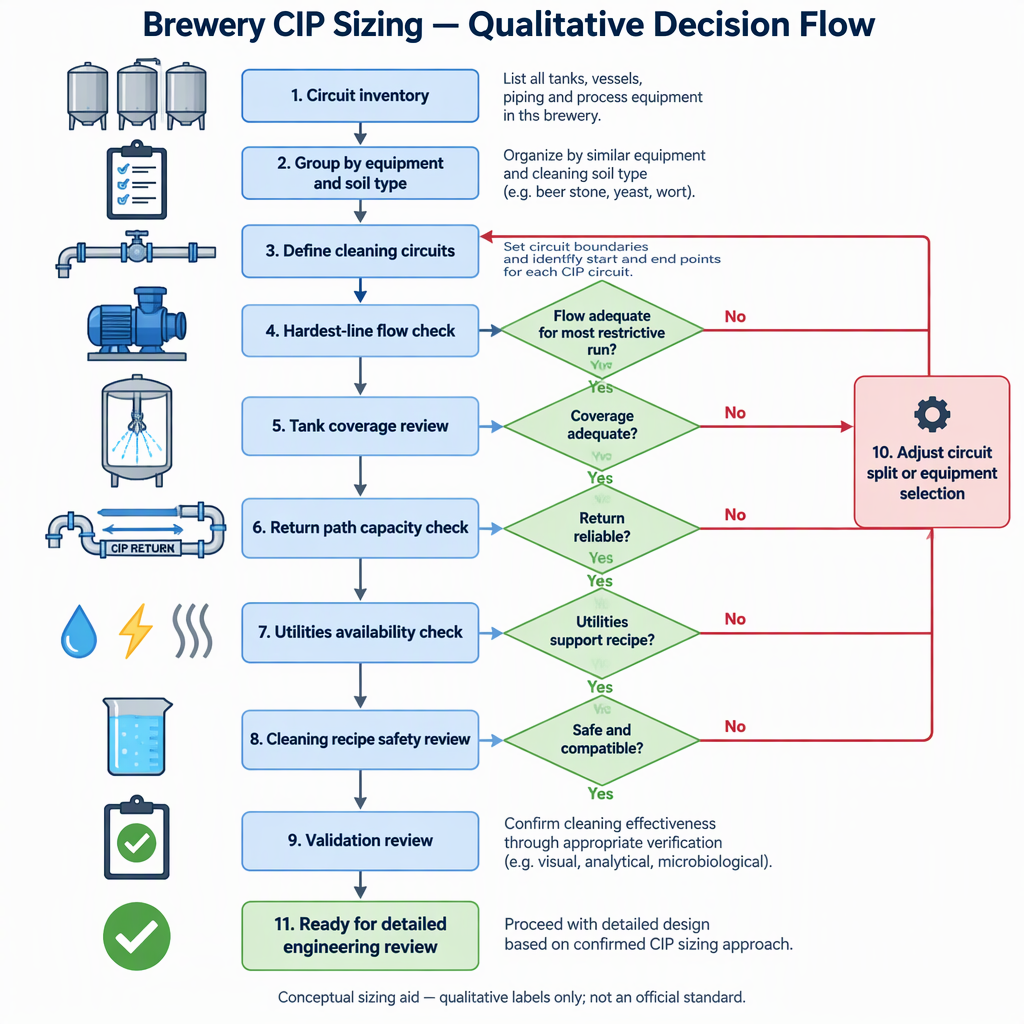
Size Flow, Pump and Return Path From the Hardest Circuit
For transfer lines, size the pump and return path from the hardest circuit after checking pipe diameter, circuit boundary, required flow condition, pressure drop and drainability.
- Choose the circuit boundary first: define where the CIP solution leaves the skid, what surfaces it contacts, and where it returns.
- Identify the limiting line: the circuit with the most demanding combination of diameter, length, fittings, elevation and pressure drop.
- Ask for flow calculations that consider velocity, Reynolds number and pressure drop for that circuit rather than a single plantwide flow assumption.
- Check whether the skid circulation and delivery functions can support the selected circuit while the control system monitors the intended cleaning step.
- Confirm that the return route drains completely enough for the next step, because poor drainability can undermine the selected flow and recipe.
Match Tank Coverage, Connection Size and Utilities
Tank sizing is not only vessel volume; the CIP system must match spray coverage, inlet and return sizing, drainability, internal finish and utility capacity.
| Tank-related factor | What to compare | Why it matters |
|---|---|---|
| Spray-device design and placement | Coverage of tank roof, sidewall, cone and fittings | Coverage gaps can leave surfaces outside the intended cleaning action. |
| CIP inlet and return size | Connection size against expected flow and return capacity | Undersized connections can restrict delivery or return even when the skid is adequate. |
| Drainability and dead legs | Tank slope, outlet design, valve pockets and short unused branches | Poor drainability and dead legs can retain soils or cleaning solution. |
| Heating and temperature control | Available utility capacity against the cleaning recipe and cycle schedule | The skid architecture may need heating and temperature-control capacity matched to actual cycles. |
- Ask the tank supplier and CIP supplier to review tank cleanability together, not as two separate purchases.
- Confirm the number of solution tanks and whether recovery steps are part of the intended brewing-equipment cleaning sequence.
- Check that the plant has enough drain capacity and access space around the skid, tanks and hoses for safe operation.
Build Cleaning Recipes and Safety Boundaries
Cleaning-cycle design should pair the recipe steps with rated equipment, chemical controls, hot-liquid precautions, pressure limits, PPE and emergency-response planning.
- Convert the brewery’s intended rinse, cleaning, recovery, acid and sanitizing steps into a controlled sequence for each circuit.
- Match each step to storage, heating, circulation, delivery and monitoring requirements on the CIP skid.
- Plan training around cleaning chemicals, hot liquids and surfaces, transfer equipment, GHS labels, SDSs, PPE and brewery-specific hazard analysis.
- Specify properly rated equipment and materials for the chemicals, temperatures and pressures used by the brewery’s CIP recipe.
- If manual inspection, unclogging or access is required before or after CIP, switch off the equipment, disconnect the applicable power or energy source, relieve stored pressure where the manual permits, and open only the access points allowed by the equipment manual.
For U.S. human-food facilities, the FDA CGMP overview describes 21 CFR Part 117 as addressing current good manufacturing practice and preventive-control requirements unless an exemption applies. Breweries outside the United States, or operating under different product categories, should confirm the current local sanitation and food-safety requirements that apply to their operation.
Validate the Specification Before Ordering
Before ordering, validate the CIP specification against the brewery’s hardest tank, hardest line, cleaning recipe, utilities, safety plan and acceptance method.
- Review tank cleanability factors in drawings, including drainability, spray coverage, internal finish, weld quality, dead legs, valve and gasket design, and CIP connection size.
- Request the pump and flow basis for the limiting line circuit, including pressure-drop assumptions and return-path limits.
- Confirm which skid modules are included: solution storage, heating and temperature control, circulation and delivery, monitoring and control, and safety-related functions.
- Confirm the training and documentation needed for chemicals, hot liquids, transfer equipment, labels, SDSs and PPE.
- Define the trial or commissioning checks that will show circulation, return, drain-down, temperature control and safe operator interaction for the selected circuits.
- Ask the supplier to list exclusions clearly: installation work, site utilities, chemicals, validation services, spare parts and operator training should not be assumed unless they are written into the purchase scope.
Conclusion
The right brewery CIP system is the one sized to your real tanks, lines, recipes, utilities and safety limits, not to a generic brewhouse volume.
Use the skid architecture as the equipment framework: solution storage, heating, circulation, delivery, monitoring, control and safety-related modules.
Use the brewery layout as the sizing framework: drainable tanks, effective spray coverage, hygienic connections, compatible line flow and a return path that supports the recipe.
- Map circuits before choosing a skid.
- Size from the hardest tank and line, not the average one.
- Turn cleaning recipes into utility and control requirements.
- Validate the specification before the purchase order is released.
FAQ: Brewery CIP System Sizing
These questions help brewery operators, brewing-process teams and engineering procurement teams challenge a CIP proposal before purchase.
What questions should I ask a supplier before buying a brewery CIP system?
Ask which solution-storage, heating, circulation, delivery, monitoring, control and safety-related modules are included, and ask how those modules match your cleaning sequence.
Also ask how the supplier checked tank drainability, spray coverage, dead legs, valve design, gasket design, CIP connection size and flow compatibility.
Is 1.5 m/s always required for brewery CIP?
No. Treat any single velocity as a design input that must be justified for the specific pipe circuit, soil load, cleaning method and acceptance criteria; do not use it as a universal brewery rule.
Can one CIP skid clean every tank and line in the brewery?
Only if the skid, connections, pump basis, return path and utilities are matched to every included circuit. A small easy tank does not prove that the hardest tank or longest line will clean properly.
What makes tanks difficult for CIP sizing?
Common tank issues include poor drainability, weak spray coverage, rough internal finish, unhygienic welds, dead legs, unsuitable valve or gasket design, and CIP connections that restrict flow.
How do cleaning cycles change equipment selection?
Cleaning cycles determine how many solution steps must be stored, heated, circulated, delivered, monitored and controlled by the skid.
What safety items should be included in a CIP sizing review?
Include corrosive chemicals, hot liquids, extreme temperatures, pressure hazards, rated equipment and materials, PPE and emergency-response planning.
Does FDA CGMP guidance apply to every brewery worldwide?
No. FDA CGMP information is U.S. regulatory context for covered human-food facilities. Global brewery projects should confirm the current sanitation and food-safety rules in the operating jurisdiction.
When should the final specification be tested?
Test or commission the selected circuits before routine production use, with attention to circulation, return, drain-down, temperature control, chemical handling and safe operator interaction.


