Engineering the Perfect Finish
In commercial brewing, the difference between a good product and a great one often lies in the finishing process. While the chemistry of fermentation is complex, the physics of conditioning—temperature control, pressure management, and carbonation—must be precise.
For technical procurement officers and head brewers, a Brite Beer Tank (BBT) is not just a storage vessel; it is a precision instrument designed to stabilize the colloidal structure of beer and prepare it for packaging.
This technical analysis explores the critical components, performance metrics, and engineering advantages of Cassman’s Brite Beer Tanks, helping you make an informed decision based on data and design.
Key Components of a Brite Beer Tank
A high-performance BBT is defined by the quality of its fittings and the integrity of its fabrication. Here is a breakdown of the critical subsystems.
1. The Carbonation Assembly
The heart of a Brite tank is the Carbonation Stone (Carb Stone).
Specs: Typically made of sintered stainless steel with a pore size of 2 microns.
Function: This microscopic porosity allows CO2 to enter the liquid as a fine mist rather than large bubbles. This maximizes the surface area for gas absorption, ensuring rapid and stable carbonation without "breakout" foaming.
2. High-Efficiency Cooling Jackets
Unlike simple storage tanks, our BBTs feature dimple plate glycol jackets.
Design: The dimpled surface creates turbulence in the glycol flow, which significantly increases the heat transfer coefficient compared to standard coil jackets.
Result: This allows for rapid "cold crashing" to near-freezing temperatures (0°C - 1°C), essential for precipitating haze proteins and stabilizing the beer.
3. Sanitary Sampling and Pressure Control
Sample Valve: We utilize sanitary, spiral-type sample valves (Perlick style) that allow for easy cleaning and prevent microbial harborage.
Pressure Relief Valve (PRV): A calibrated mechanical valve that protects the tank from over-pressure during carbonation and vacuum collapse during CIP (Clean-in-Place) cycles.
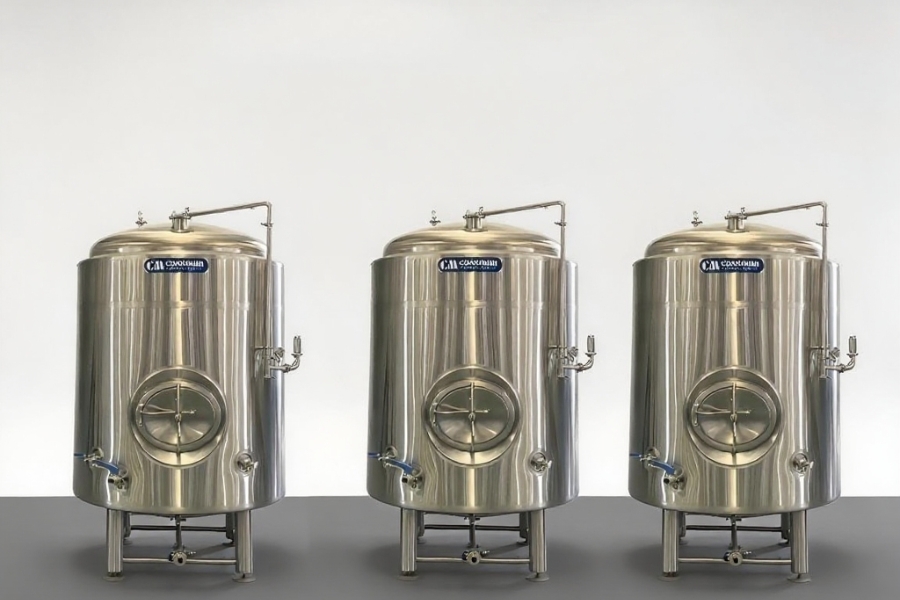
Performance Metrics: Measuring Efficiency
When evaluating Brite beer tank performance, three key metrics determine the ROI of the equipment.
1. Carbonation Efficiency
Time is money. A well-engineered BBT with proper stone placement and geometry can fully carbonate a batch in less than 12-24 hours.
Poor design: Improper stone placement leads to stratification, requiring days of recirculation pump usage to equalize carbonation.
Cassman design: Optimized geometry ensures natural convection currents mix the CO2 evenly.
2. Thermal Insulation Performance
Energy loss is a silent cost. Our tanks use high-density Polyurethane (PU) foam insulation (typically 80-100mm thickness).
3. Cleaning Cycle (CIP) Effectiveness
The interior finish affects cleaning time.
Surface Finish: Cassman tanks are polished to Ra < 0.4μm. This "mirror-like" finish prevents beer stone (calcium oxalate) adhesion.
Shadowless Manways: We use oval manways installed flush with the tank wall, eliminating "shadow zones" where spray balls cannot reach.
Comparative Analysis: Brite Tank vs. Unitank
A common technical debate is whether to use a Unitank for everything or invest in dedicated Brite tanks. Here is the operational comparison.
Feature | Unitank (Fermenter) | Brite Beer Tank (BBT) |
Tank Geometry | Conical Bottom (60°) | Dished / Torispherical Bottom |
Primary Function | Fermentation & Yeast Harvesting | Carbonation, Clarification, Serving |
Carbonation Speed | Slower (Less surface area for stone) | Faster (Optimized geometry) |
Beer Clarity | Good (after yeast dump) | Superior (Final sedimentation) |
Volume Accuracy | Variable (due to yeast cake) | Precise (Calibrated for packaging) |
Pressure Rating | Typically 1-2 Bar | Typically 2-3 Bar (Higher for faster carb) |
The Verdict: While Unitanks offer flexibility, Brite Tanks offer efficiency. For production breweries, moving beer to a BBT frees up the more expensive Unitank for the next brew immediately, increasing annual cellar throughput by 15-20%.
Conclusion
Selecting the right Brite Beer Tank is a balance of material science, thermodynamic design, and sanitary engineering.
For breweries aiming for high throughput and consistent packaging quality, the technical advantages of a dedicated BBT—rapid carbonation, superior temperature holding, and precise pressure control—make it an indispensable asset.
At Cassman, we engineer our tanks to meet the rigorous demands of modern brewing technology, ensuring that your equipment performs as flawlessly as your recipe.
Technical Consultation
Need specific pressure ratings or custom dimensions for your cellar? Contact our engineering team to discuss your technical requirements.
Frequently Asked Questions (FAQ)
Q: What is the standard pressure rating for your Brite Tanks?
A: Our standard BBTs are designed for a working pressure of 0.2 MPa (2 Bar / 30 PSI) and are tested at higher pressures to ensure safety. We can also manufacture high-pressure tanks for specific needs (e.g., soda or sparkling wine).
Q: Why do Brite Tanks have a dished bottom instead of a cone?
A: Since the yeast has already been removed in the fermenter, a steep cone is unnecessary. A dished bottom is structurally stronger, handles pressure better, and reduces the overall height of the tank, making it easier to fit in low-ceiling cellars.
Q: Can I use a Brite Tank for fermentation in an emergency?
A: Technically yes, but it is not recommended. Without a conical bottom, harvesting yeast is nearly impossible, and the sediment will settle across the entire floor of the tank, potentially leading to off-flavors (autolysis) if left too long.
Q: What type of glycol connection do you use?
A: We typically use standard NPT or BSP threaded connections, or Tri-Clamp fittings depending on the customer's piping requirement. The jackets are zoned to allow for partial batch cooling.


