The Brewer's First Defense
In the brewing industry, there is a saying: "Brewers are essentially janitors who make wort." It’s a humorous truth, but the consequences of poor sanitation are no joke. A single bacterial infection can force you to dump an entire batch, costing thousands of dollars in lost revenue and damaging your brand's reputation.
While chemical protocols are important, the sanitary design of your equipment is your first line of defense. If your tank has microscopic scratches or physical "dead zones," no amount of caustic soda will save your beer.
In this guide, we explore the critical engineering features—from sanitary welding to surface finishes—that make a fermenter truly "CIP Ready."
Understanding Ra Finish: The Microscopic Battlefield
When you look inside a stainless steel tank, it might look smooth to the naked eye. But under a microscope, steel can look like a mountain range.
What is Ra?
Ra (Roughness Average) is the measure of the texture of a surface. In brewing, the lower the Ra value, the smoother the surface, and the fewer places there are for bacteria and wild yeast to hide.
The Cassman Standard: Ra < 0.4µm
We strictly adhere to a sanitary finish of Ra ≤ 0.4µm for the interior of all our Beer Fermenters.
Mechanical Polishing: We grind down the welds to be perfectly flush with the tank wall.
Pickling & Passivation: We use acid treatments to remove impurities and create a passive chromium oxide layer that resists corrosion.
The Result: A mirror-like finish where soil and organic matter (trub) cannot cling, allowing them to be easily washed away during the cleaning cycle.
Dead Corners & Shadowless Manways
A "dead corner" is any area inside the tank that the spray ball's water jet cannot reach directly. The most common culprit in older tank designs is the manway (the door).
The Problem with Standard Manways
Traditional manways often have a "neck" or a protrusion that extends into the tank. When the spray ball activates, this neck creates a "shadow"—a dry zone behind the lip where the cleaning solution doesn't hit. This is a breeding ground for contaminants.
The Solution: Shadowless Manways
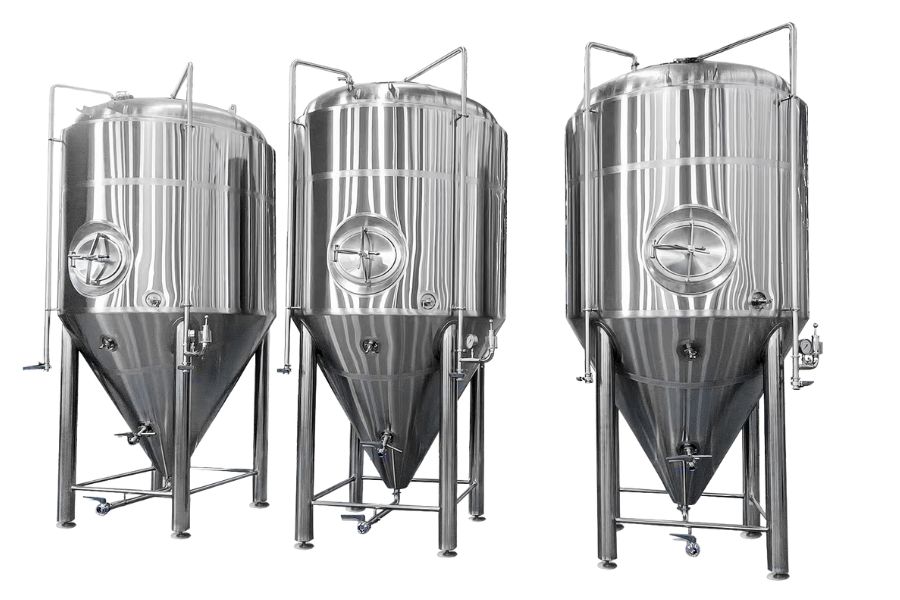
Cassman tanks feature Shadowless Manways.
Flush Design: The door sits perfectly flush with the interior wall of the tank.
No Hiding Spots: There is no lip or neck to block the spray. The water cascades over the entire surface evenly.
Sanitation: This ensures 100% coverage during the CIP cleaning brewery tanks process, eliminating the need for manual scrubbing.
The CIP Process: Automated Hygiene
CIP (Clean-In-Place) is the method of cleaning the interior surfaces of pipes and vessels without disassembly. A well-designed tank makes this process efficient and reliable.
The Rotary Spray Ball
Every Cassman fermenter comes equipped with a rotary spray ball. unlike static balls (which just drill holes in the dirt), rotary balls spin under pressure, creating a high-impact scrubbing action that covers 360 degrees of the tank interior.
Optimized Piping
Our CIP arms are designed with sanitary tri-clamp connections and smooth bends to ensure laminar flow. This guarantees that the cleaning solution reaches the spray ball at the correct pressure to blast away yeast rings and hop residue.
Maintenance Tips: Don't Forget the Gaskets
Even with the best steel finish, your fermenter sanitation can be compromised by soft parts.
Inspect Gaskets: The EPDM or Silicone gaskets on your butterfly valves and manways are porous compared to steel. Over time, they can develop micro-cracks.
Routine Replacement: We recommend inspecting these every 6 months and replacing them annually.
Valve Breakdown: Always disassemble your sample valves and racking arms periodically for a deep soak, as these are complex parts where beer stone can accumulate.
Conclusion
Sanitary design isn't just a feature; it's the foundation of quality brewing. A tank that is easy to clean is a tank that produces consistent, fresh beer batch after batch.
At Cassman, we don't cut corners on polishing or welding because we know that in the cellar, hygiene is everything.
Ready to upgrade your cellar's hygiene standards?
Don't let old equipment risk your beer quality. Click here to get a quote for our sanitary-grade, CIP-ready fermenters and see the difference precision engineering makes.
Frequently Asked Questions (FAQ)
Q: What is the difference between Sanitary Weld and Regular Weld?A: A sanitary weld (TIG weld) is smooth, non-porous, and free of pits or crevices. It is ground down and polished to match the surrounding surface (Ra < 0.4µm) so that bacteria cannot colonize the seam.
Q: How does a Shadowless Manway work?A: It is mounted on a specialized oval pad that matches the curvature of the tank. This allows the door to close flush against the inner wall, eliminating the "neck" that typically blocks water from the spray ball.
Q: Static Spray Ball vs. Rotary Spray Ball: Which is better?A: For fermenters, Rotary Spray Balls are superior. They provide mechanical scrubbing action through impact and ensure 100% coverage. Static balls are cheaper but less effective at removing heavy soil like dried yeast rings (krausen).
Q: What is Passivation?A: Passivation is a chemical process (usually using nitric or citric acid) that removes free iron from the surface of the stainless steel and enhances the natural protective oxide layer, preventing rust and metallic off-flavors.


