2025 Small Craft Brewery Launch Guide: 9 Steps From Zero to One
By Elena Martinez — Founder of Two Rivers Brewing (sold 2023), Advisor to 14 Startups, Certified Cicerone® & Food Safety Lead Auditor
If you’re reading this, you’ve probably already tasted your dream beer in your head.
Now you need to build the machine that makes it real—without burning cash, missing permits, or opening six months late.
I’ve helped launch breweries from Brooklyn to Boise. Some succeeded fast. Others failed quietly—not from bad beer, but from misaligned equipment, permit surprises, or cash running out before the first keg sold.
This guide cuts through the noise. It’s the exact 9-step playbook I use with new founders—updated for 2025’s realities: tighter lending, stricter wastewater rules, and smarter, modular equipment.
No fluff. Just what works.
Step 1: Pick Your Business Model—Before You Sign a Lease
Your model dictates everything: tank size, packaging, margins, even your taproom music.
Most new brewers fall into one of three paths:
Model | Best For | Key Risks |
Taproom-First | Urban spaces, community focus, high-margin draft | Overbuilding capacity; underestimating labor |
Wholesale-Focused | Rural/industrial zones, volume-driven | Thin margins; distributor dependency |
Hybrid (DTC + Draft) | States with legal e-commerce (e.g., CO, OR, NY) | Complex compliance; inventory complexity |
Ask this first:
“Will I make money on batch #1—or only on batch #50?”
Action:
Define your core 3 beers (repeatable, low-cost)
Add 2 seasonals/year for hype
Price by channel: Draft = 70%+ gross margin; cans = 45–55% after packaging
Pro Tip: In 2025, taproom-only models are outperforming—especially with experiential add-ons (brewer Q&As, can-release parties, membership tiers).
Step 2: Permits & Compliance—Start Here, Not Later
In 2025, the TTB (U.S.) and equivalent agencies globally demand more documentation—not less.
You’ll likely need:
Federal Brewer’s Notice (TTB) + State Alcohol License
Local health department food production permit
Fire marshal approval (CO₂ storage, glycol, electrical)
Wastewater discharge permit (pH, BOD limits—often overlooked!)
Critical 2025 updates:
Batch traceability is now required in CA, NY, TX, and EU markets
HACCP plans are expected—even for nano breweries selling only on-site
Allergen controls (e.g., gluten, fruit purees) must be documented
Do this now:
Draft a process flow diagram (raw → finished)
Create a master sanitation log template
Assign a Preventive Controls Qualified Individual (PCQI)—even if it’s you
Permit delays average 8–12 weeks in 2025. Submit early—and attend pre-application meetings.
Step 3: Site Selection—Utilities Trump Aesthetics
The “cool warehouse” with no 3-phase power will cost you $50K in retrofits.
Non-negotiables:
Water: Test hardness, chlorine, and microbial load. RO systems need drainage for 25–30% reject water.
Power: 480V 3-phase for electric brewhouses. Confirm transformer capacity.
Drainage: Minimum 4" floor drains with grease interceptor (health codes).
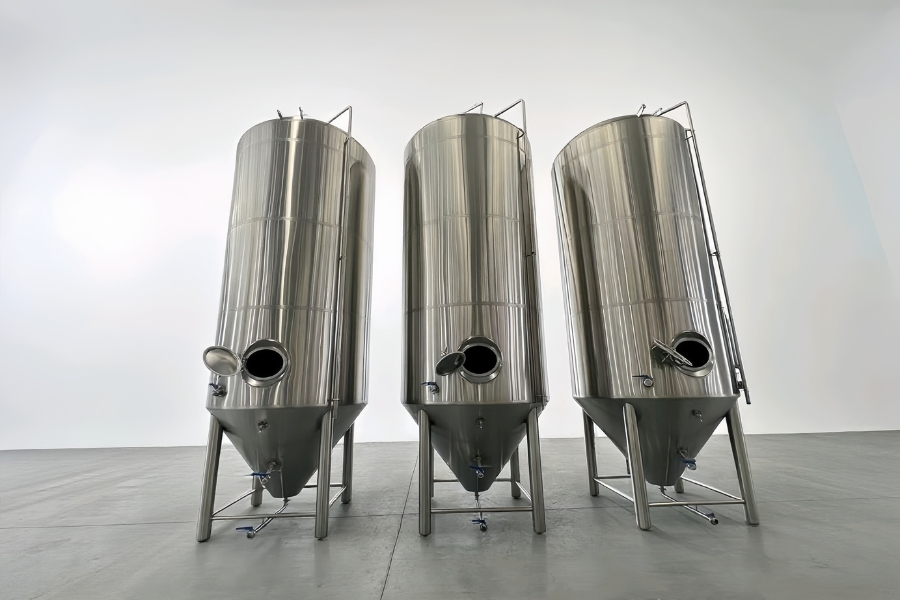
Headroom: 16'+ for 15-BBL conicals + platforms.
Slab: Verify 250+ PSI load rating—fermenters weigh 10K+ lbs full.
Layout rule:
One-way flow only—no cross-traffic between raw grain and finished beer.
Red flag: Shared loading docks or residential neighbors (noise/odor complaints kill permits).
Step 4: Equipment—Buy Smart, Not Big
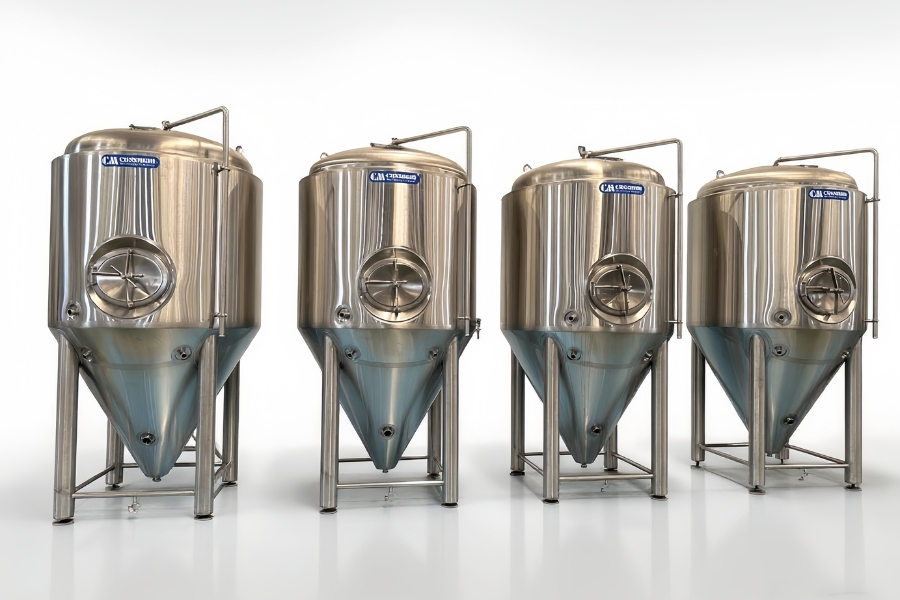
Most new brewers over-invest in brewhouse size and under-invest in tanks.
Realistic 2025 starter setup (7–15 BBL):
Component | What to Buy | Where to Save |
Brewhouse | 3-vessel (mash/lauter, kettle, whirlpool), semi-auto PLC | Skip full automation unless doing 5+ batches/week |
Fermenters | 6–8 conicals (10–20 BBL each), ASME-certified, 60° cones | Used is OK—if pressure-tested & jacket intact |
Brite Tanks | 2–3, same size as fermenters | Essential for clarity & carbonation control |
Packaging | Start with draft only (keg washer/filler) | Add canning line after 6 months of sales proof |
QA Lab | DO/CO₂ meter, pH, hydrometer, microscope | Non-negotiable for consistency |
Key spec checks:
Stainless: 304 OK for most; 316L only for sours/high-chloride water
Welds: Fully orbital, no pits or discoloration
Fittings: Tri-clamp only—no NPT threads inside process lines
New vs. Used? Buy new brewhouse & controls, used tanks (if certified). Avoid used glycol chillers—they fail silently.
Step 5: Recipes & Process Control—Consistency > Creativity
Your first IPA might win awards. Your 20th better taste the same.
Control these critical points:
Mash pH: 5.2–5.4 (use acidulated malt or lactic acid)
Whirlpool temp: <200°F for hop aroma retention
Fermentation: Pitch at 64°F, ramp slowly; dry hop under CO₂ blanket
Cold crash: 32°F for 48+ hours to drop haze
Document everything:
Batch sheets with actual vs. target temps, gravities, timings
Sensory notes (even if just you and a friend)
Retention samples (store 4 bottles/batch at 38°F for 6 months)
QA isn’t optional—it’s your wholesale ticket. Distributors now require COAs and HACCP alignment.
Step 6: Quality & Safety—Build It In, Not On
Food safety = business continuity.
Minimum viable QA system:
HACCP Plan with 3–5 CCPs (e.g., pasteurization, sanitation, cold chain)
CIP Validation: Swab or ATP tests on tank walls, valves, hoses
CO₂ Monitors: Required in cellar rooms (OSHA/NIOSH)
Allergen Protocol: Dedicated lines or full clean between fruit/specialty batches
Worker safety must-haves:
Lockout/tagout for pumps & agitators
Eyewash stations near chemical storage
Confined space permit for tank entry
️ Tip: Run a mock recall before opening. Can you trace a batch from keg back to malt lot in <2 hours?
Step 7: Brand & Marketing—Sell Before You Brew
Great beer in a quiet taproom = expensive hobby.
2025 marketing levers that work:
Pre-launch email list: Offer “Founding Member” discounts for sign-ups
Taproom experience: Brewer chats, “Meet the Yeast” nights, can art reveals
Wholesale onboarding: Provide line-cleaning kits and tap handle + POS
Content: Short videos of brew day, water profile explainers, hop farm tours
Pricing strategy:
Draft: $6–8/pint (urban), $5–7 (suburban)
4-packs: $16–22 (position as premium but accessible)
Never discount core beers—use seasonals for promotions
Your first 100 customers should be your marketers. Give them reasons to post.
Step 8: Financial Model—Protect Your Passion with Numbers
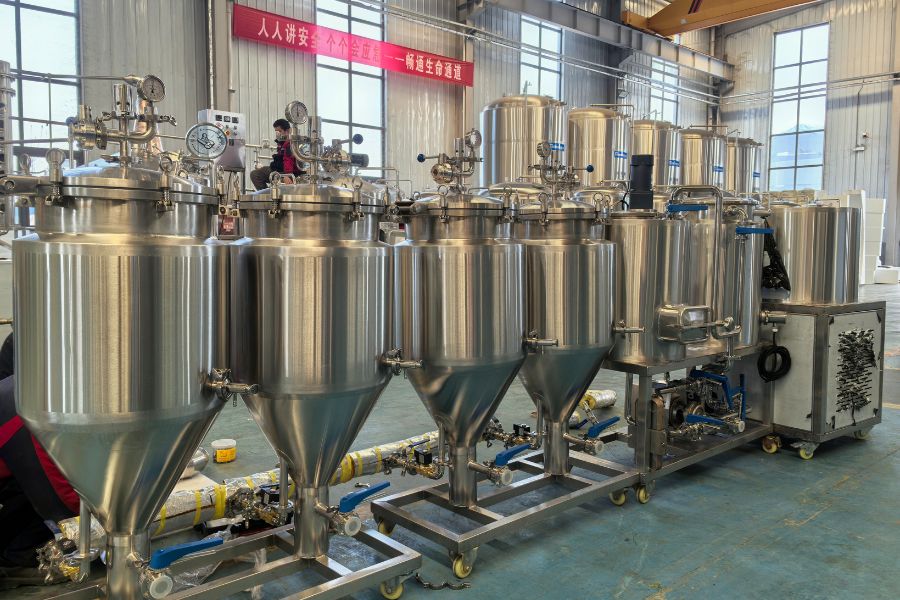
Passion doesn’t pay glycol bills.
Typical 2025 startup budget ($250K–$500K range):
Category | % of Total | Notes |
Facility Build-Out | 25–35% | Includes drains, HVAC, electrical |
Equipment + Install | 45–55% | +15–20% for shipping/commissioning |
Permits & Fees | 5–8% | TTB, state, health, fire |
Working Capital | 15–20% | 4–6 months of payroll, grain, hops, utilities |
Key metrics to track weekly:
Batches/week vs. plan
First-pass yield (target >92%)
Gross margin by channel (taproom should fund wholesale losses early)
Cash runway (never drop below 8 weeks)
Funding tip: Equipment leasing (e.g., through Cascadia or SMB Leasing) preserves cash for ops.
Step 9: Timeline & Risk Control—6–9 Months, No Excuses
A realistic, overlapping schedule beats an optimistic Gantt chart.
Aggressive but achievable timeline:
Month | Key Milestones |
1–2 | Finalize model, site shortlist, draft budget, talk to 3 equipment vendors |
2–3 | Sign lease, submit TTB app, lock equipment PO, begin health dept pre-check |
3–5 | Build-out + utility work; pilot recipes; order first grain/hops |
5–6 | Equipment delivery/install; hire head brewer; run FAT/SAT |
6–7 | Trial batches; stability testing; soft launch (friends/family) |
7–9 | Grand opening; weekly KPI reviews; plan first seasonal |
Top 3 risks—and how to beat them:
Permit delays → Submit TTB + local apps in parallel; hire a permit expeditor if in CA/NY
Equipment lead times → Lock delivery date in contract with liquidated damages clause
Cash crunch → Stage purchases (e.g., buy 4 fermenters now, 2 later); pre-sell memberships
FAQ: Real Questions from Founders Like You
Q: What’s the smallest viable brewhouse size in 2025?
A: 7–10 BBL is the sweet spot. It fits in 1,200–1,800 sq ft, supports 3–5 batches/week, and keeps CAPEX under $300K.
Q: New vs. used equipment—what’s safe?
A: New: brewhouse, controls, glycol chiller. Used: fermenters/brites—if ASME-certified, pressure-tested, and jacket intact. Never buy used pumps or heat exchangers.
Q: Do I really need a full HACCP plan?
A: Yes. Even taproom-only. Health departments now require it, and it’s your defense if a customer claims illness.
Q: How much for installation?
A: Budget 15–25% of equipment cost. Example: $200K system = $30K–$50K install + commissioning.
Final Thought: Launch Lean, Learn Fast, Scale Smart
Your first system doesn’t need to last 20 years. It needs to get beer in glasses, generate cash, and teach you what your customers actually want.
The best breweries I’ve seen started small, obsessed over consistency, and reinvested profits—not debt—into growth.
If you’re serious, start with Step 1 today: write down your model, your first 3 beers, and your break-even batch count.
Then email me: inquiry@cassmanbrew.com
Tell us your:
We’ll send you a custom equipment BOM, floor layout rationale, and 6-month launch Gantt—no sales call required.
Because in 2025, the best breweries aren’t built on dreams. They’re built on plans that ship.


