Why This Guide Exists
If you’re sourcing your first brewhouse or expanding your production line, you’re not just buying stainless steel—you’re investing in consistency, safety, and scalability. Yet too many new brewers sign purchase orders based on glossy brochures, lead times, or upfront price alone—only to face infection outbreaks, failed CIP cycles, or utility bottlenecks months later.
This guide cuts through the noise. Based on real-world commissioning reports, QA audits, and lessons from breweries that scaled (and those that stalled), we outline the five most common—and preventable—equipment buying mistakes. No vendor bias. No fluff. Just actionable checks you can use before wiring a deposit.
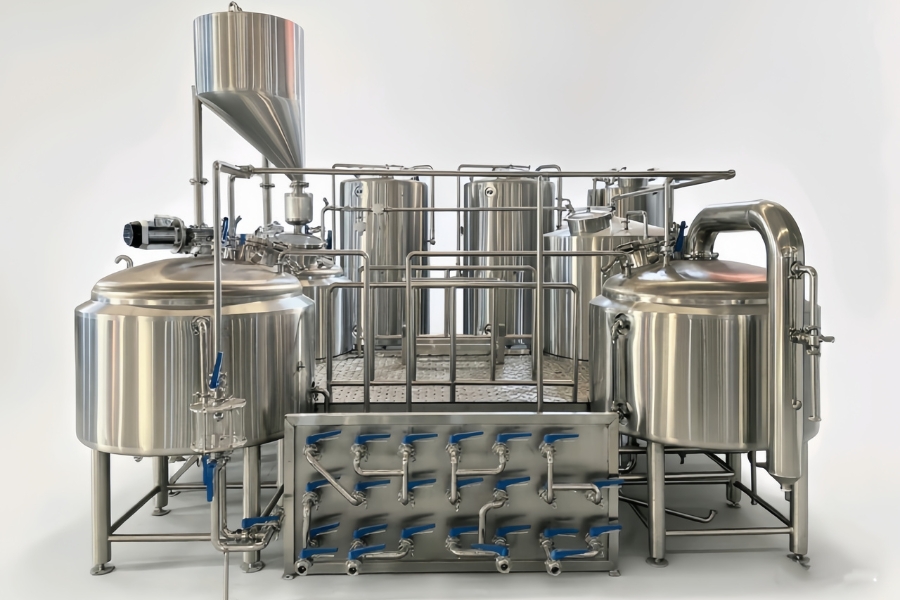
Mistake #1: Assuming “Stainless Is Stainless” — Ignoring Sanitary Design
The trap: “It’s all 304 stainless,” says the quote. But material grade is just the start. Poor welds, dead legs, and rough surfaces become biofilm incubators—especially in fermenters and bright tanks.
What Actually Matters:
Material: 304 is acceptable for most hot-side and fermentation vessels. Use 316L only if you’re running frequent hot caustic/acid cycles or brewing sour beers.
Surface finish: Product-contact surfaces should be electropolished to Ra ≤ 0.8 μm (ideally ≤ 0.6 μm). Ask for mill test reports and surface roughness certificates.
Welds: Must be fully penetrated, passivated, and free of pits or discoloration. Insist on internal boroscope inspection during FAT.
Dead legs: Piping branches should follow the <1.5× pipe diameter rule. Avoid blind tees, unnecessary valves, or oversized manways.
Pro Tip: Require a CIP coverage map from the vendor—showing spray ball reach, flow rates, and validation method. If they can’t provide it, walk away.
Mistake #2: Sizing the Brewhouse—but Not the Utilities
You can brew 10 BBL batches all day, but if your glycol chiller can’t handle concurrent cold crashes, or your boiler lacks steam reserve, you’ll bottleneck before your first keg leaves the dock.
Critical Utility Checks:
System | Rule of Thumb | Red Flag |
Glycol | Size for peak simultaneous load (e.g., 2 fermenters cold crashing + 1 bright tank + packaging) + 25% buffer | Single-stage chiller with no redundancy |
Steam/Electric Heat | Confirm time-to-boil (e.g., 60–90 min for 10 BBL) and step-mash ramp capability | Vendor assumes your 3-phase power is available—without verifying |
Drains & Floors | Continuous 1–2% slope to trench/slot drains; chemical-resistant epoxy or urethane flooring | Flat floors, puddling, or PVC drains near hot-side |
Ventilation | Kettle stack must vent outdoors; CO₂ monitors in cellar; combustion air for gas-fired systems | No make-up air plan—risk of negative pressure or incomplete combustion |
Pro Tip: Demand a utility matrix with kW/BTU, flow (GPM), pressure (PSI), and voltage/phase specs— before finalizing layout.
Mistake #3: Treating CIP as an Afterthought
“If it looks clean, it is clean” is a recipe for diacetyl spikes, haze, and recalls. Cleanability isn’t optional—it’s your first line of QA.
Non-Negotiables for Validated Cleaning:
Spray devices: Rotating or fixed spray balls sized to tank volume (e.g., 3–5 GPM per 10 BBL). No undersized “decorative” balls.
CIP skid: Minimum two-tank system (caustic + acid/hot rinse). Add conductivity sensors to verify concentration and temperature logging.
Elastomers: Use EPDM for general use, Viton for high-temp/acid, or PTFE for aggressive chems. Get a compatibility chart.
Validation: Require ATP swab tests or protein residue checks post-CIP during SAT.
Pro Tip: Include a CIP validation protocol in your purchase agreement—defining pass/fail criteria for flow, time, temp, and residue.
4: Buying “Smart” Controls You Can’t Maintain
A touchscreen HMI looks impressive—until it crashes during a boil, and the vendor says, “That’s a proprietary PLC. Only our engineer can fix it.”
What to Demand in Controls:
Open architecture: Avoid locked-down systems. Require documented PLC code (Ladder/Structured Text) and standard HMI (e.g., Siemens, Allen-Bradley).
Critical monitoring: Real-time trending for fermentation temp, glycol pressure, DO (if canning), and brite tank CO₂.
Alarms & overrides: Audible/visual alarms for high temp, low glycol flow, or pressure loss—plus manual valve overrides.
Support: Local service partner? Remote diagnostics? Spare parts list with lead times?
Pro Tip: Run a FAT script that tests: recipe repeatability, alarm triggers, interlocks (e.g., can’t open manway under pressure), and data export.
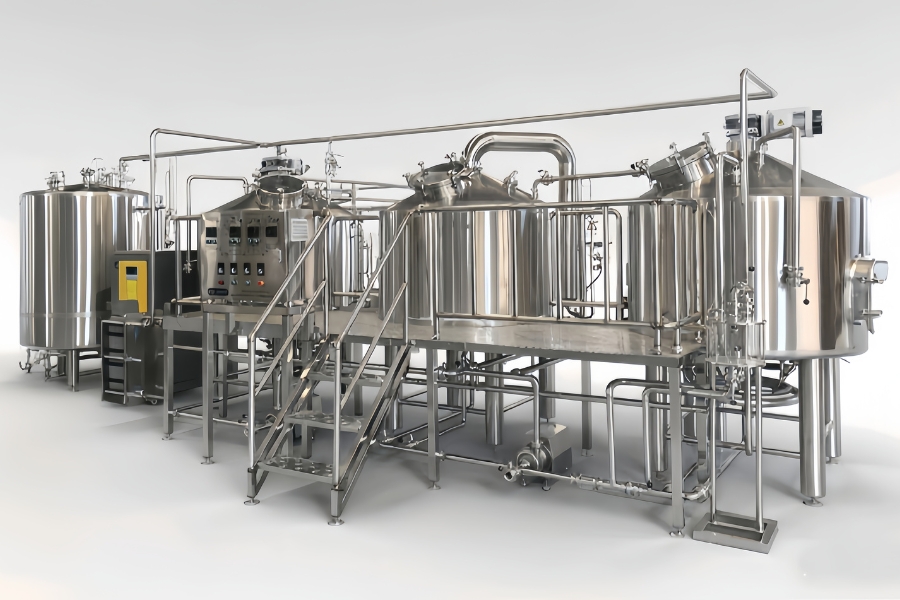
Mistake #5: Chasing the Lowest Price—Ignoring Total Cost of Ownership (TCO)
A $120K brewhouse might seem like a steal—until you spend $40K on rigging, $15K on steam upgrades, and lose 3 batches to dissolved oxygen (DO) spikes from a cheap canning line.
TCO Breakdown (5-Year View):
Category | Hidden Costs to Budget |
Installation | Rigging, sanitary piping, electrical panels, steam/gas lines, ventilation, floor drains |
Commissioning | Training, FAT/SAT travel, calibration of sensors, water treatment setup |
Operations | Energy use (kWh/BBL), chemical consumption, spare parts (gaskets, seals, pumps) |
Quality & Risk | DO meters, seam testers, lab tests, downtime from poor support |
Pro Tip: Ask vendors for annual maintenance cost estimates and energy consumption at full duty cycle. Compare TCO—not just CAPEX.
New vs. Used: Where to Save (and Where Not To)
Equipment | Safe to Buy Used? | Must-Test Before PO |
Brewhouse | ❌ Avoid | — |
Fermenters / Bright Tanks | ✅ Yes—if inspected | Hydro test, jacket pressure test, internal boroscope for pitting |
Canning Line | ⚠️ Only if DO-controlled | Require DO < 50 ppb validation; seam integrity tests |
Chiller / Boiler | ❌ Avoid | Efficiency curves, refrigerant logs, safety valves |
Controls / Sensors | ❌ Never | Calibration certs, firmware version, spare part availability |
Rule of thumb: Buy new for anything affecting product safety or repeatability (controls, chillers, canning). Go used only for passive vessels—and always test.
Your Pre-Purchase Checklist: Due Diligence That Pays Off
Before signing:
Get 3 references with similar batch size and output
Review as-built P&IDs and welding/passivation certs
Confirm FAT/SAT scope in writing (include CIP, temp stability, pressure tests)
Require 12–24 month warranty with <72-hour response time
Negotiate training, spare kit, and remote support into the contract
Final Thought: Equipment Is Your Silent Brewmaster
Your brewhouse doesn’t take days off. It doesn’t “wing it.” It either performs to spec—or it doesn’t. The difference between a smooth launch and a costly retrofit often comes down to three things:
Sanitary design that’s inspectable,
Utilities sized for reality—not theory,
Validation built into the purchase—not bolted on after.
Spend the extra week on due diligence now. Your future QA team—and your customers—will thank you.
FAQs
Q: Is 304 stainless steel sufficient for fermenters?
A: Yes—for most ales and lagers, 304 with proper passivation and Ra ≤ 0.8 μm finish is adequate. Use 316L only for frequent acid washing or sour production.
Q: How do I verify CIP coverage before buying?
A: Require a vendor-provided spray pattern diagram, minimum flow/pressure specs, and include a live CIP demo in your FAT. Validate with dye tests or ATP swabs during SAT.
Q: What’s the most common hidden installation cost?
A: Utility upgrades—especially 3-phase power, steam line pressure, glycol loop sizing, and sloped, chemical-resistant flooring. Always get a site survey before finalizing layout.
Need a vendor-neutral spec sheet or utility matrix?
Tell us your:
We’ll send you a custom RFP-ready checklist with FAT/SAT criteria and utility requirements.


