The Stage for the Performance
Great wine starts in the vineyard, but it is defined in the cellar. Once the grapes are harvested and crushed, the wine tank becomes the most critical tool in the winemaker's arsenal. It is not merely a container; it is a controlled environment where biology and chemistry transform juice into a complex beverage.
Whether you are producing a crisp Sauvignon Blanc or a bold Cabernet Sauvignon, the vessel you choose dictates the control you have over temperature, oxidation, and clarity.
In this article, we explore the main uses of wine tanks in the winemaking process and how Cassman Wine Tanks are engineered to support each stage of production.
Definition of Wine Tanks
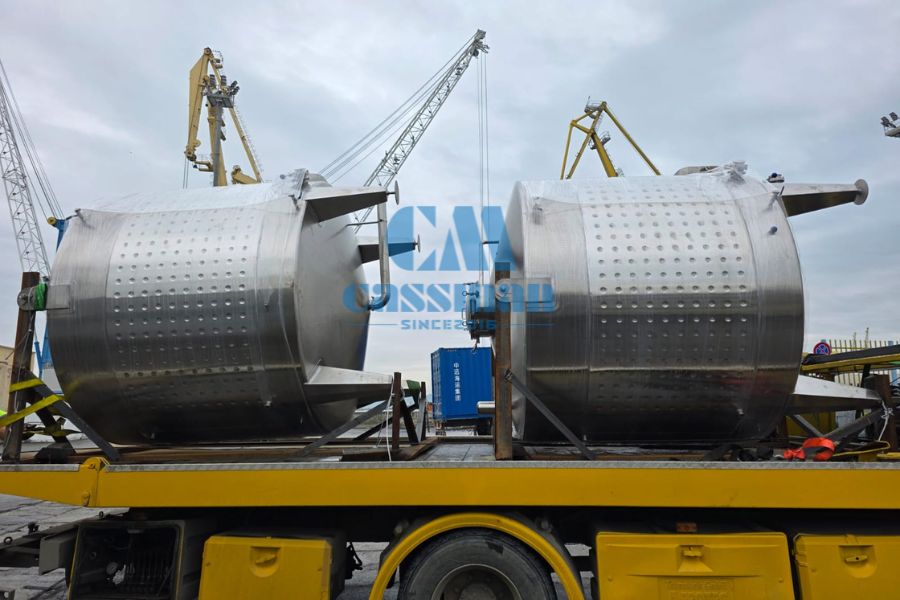
A wine tank is a specialized vessel, typically made of food-grade stainless steel (304 or 316), designed to hold wine during various production phases. Unlike simple storage drums, professional wine tanks feature advanced engineering such as:
Cooling Jackets: For precise temperature regulation.
Sloped Bottoms: For sediment management.
Sanitary Fittings: To prevent bacterial contamination.
Main Uses of Wine Tanks in the Winemaking Process
A single tank can often serve multiple purposes, but specific designs are optimized for specific steps. Here is how they function at each stage.
1. Fermentation (The Transformation)
The Function: This is the primary use of a wine fermentation tank. Yeast consumes sugar and produces alcohol, heat, and CO2.
Temperature Control: Fermentation generates significant heat. If it gets too hot, yeast can die or produce off-flavors. Our tanks use dimple cooling jackets to keep white wines cool (preserving fruity aromas) and red wines at the optimal range for color extraction.
Cap Management: For red wines, the grape skins rise to the top. Fermentation tanks are designed with large manways or pump-over systems to mix these skins back into the juice.
2. Clarification (Settling and Racking)
The Function: After fermentation, the wine is cloudy with dead yeast (lees) and grape solids.
The Process: The wine is allowed to sit undisturbed. Gravity pulls the heavier solids to the bottom.
Tank Design: Tanks used for clarification typically feature a conical or sloped bottom. This allows the winemaker to drain the clear wine from a racking arm located above the sediment, while the sludge is drained from the bottom port.
3. Carbonation (The Sparkle)
The Function: For sparkling wines (Prosecco style) or carbonated wine coolers, you need to introduce bubbles.
The Equipment: This requires a Brite Tank. Unlike standard tanks, Brite tanks are pressure-rated (capable of holding internal pressure).
How it Works: A carbonation stone diffuses CO2 into the cold wine under pressure, creating fine, persistent bubbles.
4. Storage (Preservation)
The Function: Once the wine is finished, it may need to be stored for weeks or months before bottling.
5. Aging (Maturation)
The Function: While oak barrels are traditional for adding flavor (vanilla, spice), stainless steel tanks are used for neutral aging.
Factors Influencing the Use of Wine Tanks
When selecting a tank from our Product List, consider these factors:
1. Volume and Headspace
For fermentation, you must buy a tank 20-25% larger than your juice volume to allow room for the foaming "cap." For storage, you want the tank to match your volume exactly to minimize air contact.
2. Material: Stainless Steel vs. Alternatives
Stainless Steel: Easy to clean, durable, temperature-controlled, and flavor-neutral. The industry standard for hygiene.
Concrete/Oak: Used for specific flavor profiles but harder to clean and maintain.
3. Versatility
For smaller wineries, a Variable Capacity Tank is the smartest investment. It can serve as a fermenter (open top), a storage tank (floating lid), and a bottling tank, offering maximum utility for the budget.
Conclusion
From the violent activity of fermentation to the quiet rest of storage, wine tanks are the unsung heroes of the winery. They provide the control necessary to turn a good harvest into a great vintage.
Understanding the specific uses—fermentation, clarification, carbonation, and storage—allows you to choose the right equipment for your specific style of wine. At Cassman, we provide high-quality stainless steel solutions for every step of this journey.
Equip Your Winery for Excellence
Whether you need a pressure-rated Brite tank for sparkling wine or a large fermenter for your harvest, Explore Cassman’s Wine Tank Solutions today.
Frequently Asked Questions (FAQ)
Q: Can I ferment and store wine in the same tank?
A: Yes. This is very common in smaller wineries. You ferment in the tank, drain the wine to remove the sediment (lees), clean the tank, and then pump the wine back in for storage. A Variable Capacity tank is ideal for this dual purpose.
Q: Why do some wine tanks have "dimpled" jackets?
A: The dimpled surface creates turbulence in the glycol coolant flowing inside the jacket. This turbulence increases heat transfer efficiency, allowing you to cool the wine faster and more precisely.
Q: How do I prevent oxidation in a partially full tank?
A: If you cannot use a Variable Capacity (floating lid) tank, you must "sparge" the headspace. This involves injecting an inert gas like Nitrogen or Argon into the empty space above the wine to create a protective blanket that pushes oxygen out.


