Home » Our Services » Blog » How Much Does It Cost to Start a Microbrewery? A 2026 Equipment and Budget Guide
How Much Does It Cost to Start a Microbrewery? A 2026 Equipment and Budget Guide
Author: Henry Chen Publish Time: 2026-08-26 Origin: Cassman
Table of Contents
Toggle
Starting a microbrewery is an exciting business opportunity—but it is also a capital-intensive project. Before choosing a brewhouse or requesting equipment quotations, brewery founders need to understand the total project budget, not just the price of the brewing tanks.
Quick Answer
The cost to start a microbrewery can range from approximately USD 100,000 for a small taproom-focused operation to more than USD 1 million for a larger production brewery with automated packaging.
Your final investment depends mainly on:
Brewhouse capacity and annual production target
Heating method: electric, steam, or direct fire
Number and size of fermenters
Packaging method: kegs, cans, or bottles
Building renovation and utility upgrades
Installation, freight, import duties, and commissioning
Local licensing, food safety, and labor requirements
For many first-time brewery founders, the biggest mistake is focusing only on the brewhouse price. A successful brewery budget must include the complete production system, facility preparation, utilities, packaging, and working capital.
What Is Included in the Cost of Starting a Microbrewery?
A brewery project normally includes five budget categories:
Brewing and cellar equipment
Cooling, CIP, and utility systems
Packaging and material handling
Building, installation, and compliance costs
Startup inventory and working capital
The proportion of each category varies by project. For example, a brewpub selling most beer on-site may begin with kegging and a small serving cellar. A distribution-focused brewery may need a canning line, larger cold storage, and higher production capacity from the beginning.
Typical Microbrewery Startup Cost by Brewery Size
The following ranges are for early-stage planning only. Actual project costs vary based on equipment configuration, local labor rates, building condition, automation level, destination country, and required certifications.
Brewery Type
Typical Brewhouse Size
Typical Business Model
Estimated Total Startup Budget*
Small brewpub / taproom
300L–500L
On-site sales, limited local distribution
USD 100,000–300,000
Small commercial microbrewery
500L–1,000L
Taproom, kegs, local wholesale
USD 200,000–500,000
Growing production brewery
1,000L–2,000L
Kegs, cans, regional distribution
USD 400,000–1,000,000+
Regional production brewery
2,000L–5,000L
Cans, bottles, wholesale distribution
USD 800,000–2,000,000+
*These figures are planning estimates, not fixed equipment quotations. Local construction, licensing, taxes, freight, installation, and packaging requirements can significantly affect the final budget.
Brewhouse Cost: The Core of Your Brewery Investment
The brewhouse is where mashing, lautering, boiling, whirlpooling, and wort production take place. It is the visual and operational center of most breweries, but it is only one part of the total system.
A commercial brewhouse may include:
Mash tun
Lauter tun
Kettle / whirlpool tank
Hot liquor tank
Cold liquor tank
Wort pump and hot water pump
Plate heat exchanger
Platform, piping, and valves
Control panel
Grain handling options
The equipment price depends on whether you select a 2-vessel, 3-vessel, or 4-vessel brewhouse, along with the heating method and degree of automation.
Key cost factors for a brewhouse
Batch size: 300L, 500L, 1,000L, 2,000L, or larger
Vessel configuration: More vessels can improve brewing efficiency and support more batches per day.
Heating method: Electric systems are often simpler to install; steam systems may offer strong performance at larger scales; direct-fired systems can be suitable where fuel and local regulations support them.
Automation level: Manual, semi-automatic, and automated controls have different investment and labor implications.
Material and finishing requirements: Stainless steel grade, tank thickness, insulation, internal polish, welding quality, and valve brands all influence long-term performance.
A brewhouse should not be selected only because it fits today’s budget. It should fit your production plan, available space, energy supply, staffing level, and realistic sales target.
Fermentation and Bright Beer Tanks: Often the Real Capacity Bottleneck
Many new brewery owners focus heavily on brewhouse size. In practice, production is often limited by fermentation capacity rather than brewhouse capacity.
Beer may occupy a fermenter for two to four weeks—or longer for lagers, barrel-aged beer, specialty products, or beers requiring extended conditioning. If you have too few fermenters, your brewhouse may remain idle even when demand is growing.
A typical cellar configuration can include:
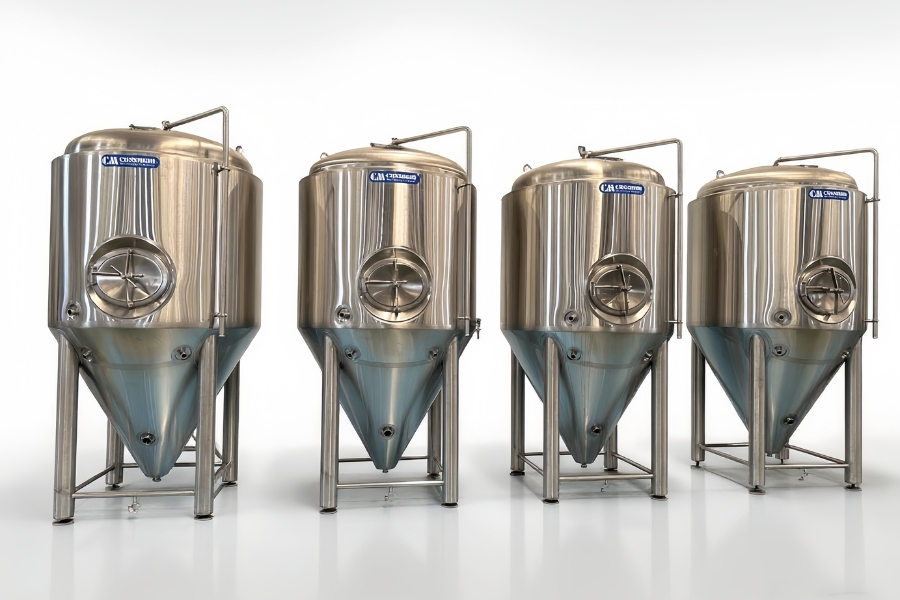
Jacketed conical fermenters
Bright beer tanks (BBTs)
Yeast brink or yeast propagation equipment
Dry hopping accessories
Carbonation equipment
Glycol piping and valves
CIP connections
A practical planning principle
For a new brewery, the cellar is usually designed around:
Expected weekly brew frequency
Average fermentation and conditioning time
Number of beer styles or SKUs
Keg, can, and taproom sales mix
Seasonal demand fluctuations
Planned expansion within the next two to three years
Example: Why a larger brewhouse is not always the answer
A brewery with a 1,000L brewhouse may produce several batches per week. However, if it has only two 1,000L fermenters, production may quickly be restricted by tank turnover time.
In many expansion projects, adding fermenters, bright beer tanks, or cold-side capacity creates a better return than immediately replacing the brewhouse.
CASSMAN supported a Canadian brewery expansion with customized 2,000L jacketed conical fermenters. This type of project shows how tank capacity can be added strategically as demand grows. Explore more real-world projects on our Global Brewery & Distillery Case Studies page.
Cooling, Glycol, and CIP Systems: Essential Costs That Are Often Underestimated
A brewhouse cannot operate reliably without properly designed supporting systems.
Glycol cooling system
The glycol system controls fermentation temperature and helps maintain product quality. An undersized glycol chiller may cause:
Slow cooling after wort transfer
Inconsistent fermentation temperatures
Difficulty cold-crashing beer
Reduced performance during hot weather
Delays when multiple tanks need cooling at the same time
Your glycol chiller must be selected based on total cooling load—not simply the number of tanks.
A Clean-in-Place system is essential for cleaning brewhouse vessels, fermenters, bright beer tanks, transfer lines, and packaging connections. Proper CIP design supports:
Stable beer quality
Lower contamination risk
More efficient cleaning procedures
Reduced manual labor
Better hygiene documentation
For small breweries, a mobile CIP cart may be suitable. For larger facilities, fixed CIP tanks and dedicated cleaning loops may offer better efficiency.
Packaging Equipment Can Change Your Brewery Budget Dramatically
Packaging is one of the largest variables in a microbrewery startup budget.
Kegging
Kegging usually requires less initial investment than canning or bottling. It can be a practical starting point for:
Taproom-focused breweries
Brewpubs
Restaurants and bars
Local draft distribution
Pilot production operations
However, keg distribution requires keg inventory, cleaning, filling, storage, and return logistics.
Canning
Canning can help breweries reach retail and wider distribution markets. It may require:
Can rinser or depalletizer
Counter-pressure can filler
Seamer
CO₂ purge system
Date coder
Conveyors
Quality-control tools
Packaging materials and cold storage
A canning line increases startup investment, but it may be necessary if your business model depends on packaged beer sales.
Bottling
Bottling can be appropriate for certain markets, premium products, or established distribution channels. However, glass handling, breakage risk, label application, storage, and logistics should be considered carefully.
Start with the sales channel—not the machine
Do not choose a packaging line simply because it is popular. First answer these questions:
Where will most of your beer be sold?
Will customers drink on-site, buy takeaway, or purchase through retailers?
What package format does your market expect?
What minimum production volume justifies packaging automation?
How many SKUs will you package?
How will you manage oxygen control and cold-chain distribution?
Facility Renovation and Utility Costs
The condition of your building can have a major effect on the total startup budget.
A brewery facility may require investment in:
Reinforced or sloped floors
Drains and wastewater connections
Three-phase electrical supply
Water filtration and treatment
Ventilation and steam extraction
Gas supply, if applicable
Boiler room or electrical heating infrastructure
Glycol chiller location and ventilation
Compressed air supply
Cold room or walk-in cooler
Loading and storage areas
Fire safety systems
Equipment access doors and ceiling-height modifications
A low equipment price does not help if the equipment cannot be moved into the building, if the floor cannot support it, or if the site lacks the required power and drainage.
Before committing to equipment, create a practical layout that considers production flow from raw materials to finished beer.
Freight, Import, Installation, and Commissioning Costs
For international brewery projects, equipment is not the only cost. Buyers should budget for the full delivery and startup process.
Typical project costs may include:
Export packaging
Inland transport to port
Sea freight or land freight
Cargo insurance
Import duties and taxes
Customs clearance
Local transportation to the brewery site
Rigging and equipment positioning
Mechanical installation
Electrical installation
Piping and utility connections
Commissioning
Operator training
Local permits and inspections
What should a reliable brewery equipment supplier provide?
A professional supplier should clearly define what is included in the quotation and what remains the customer’s local responsibility.
For a turnkey or semi-turnkey project, ask whether the supplier can provide:
Brewery layout drawings
P&ID drawings
Tank drawings
Electrical connection diagrams
Process flow charts
Utility requirement lists
Remote installation guidance
On-site installation and commissioning support
Operator training
Spare parts recommendations
Warranty and after-sales support
At CASSMAN, our engineering team can support brewery projects with layout planning, P&ID drawings, electrical diagrams, process flow documentation, equipment drawings, installation guidance, and on-site technical service when required.
Learn more about our experience and project support at the CASSMAN homepage.
Example Budget: Starting a 1,000L Microbrewery
The following is an example of how a 1,000L brewery budget may be structured. It is not a quotation and should be adjusted for your country, site, production plan, and preferred equipment configuration.
Budget Category
Typical Share of Project Budget
Brewhouse and hot-side equipment
20%–30%
Fermenters and bright beer tanks
20%–30%
Glycol, CIP, pumps, and process piping
10%–15%
Packaging equipment
10%–25%
Building renovation and utilities
15%–30%
Freight, installation, commissioning, and contingency
10%–20%
For a 1,000L brewery, a keg-focused startup may require a substantially different investment from a brewery planning a fully automated canning operation and regional distribution.
The best way to control the budget is to define your sales model and production plan before finalizing equipment.
How to Reduce Startup Cost Without Creating Long-Term Problems
Reducing unnecessary startup expenditure is important. However, cutting the wrong items can increase operating costs, product-quality risk, and expansion costs later.
Good ways to control your initial budget
Start with a realistic production capacity.
Choose a modular system that supports future tank additions.
Design utilities with practical expansion allowances.
Start with kegging if your sales channel supports it.
Select semi-automatic controls where full automation is not yet justified.
Use a professional layout before purchasing equipment.
Compare total project scope, not only individual tank prices.
Keep a contingency fund for installation and unexpected site work.
Areas where cutting cost can create problems
Undersizing the glycol chiller
Buying too few fermenters
Ignoring floor drains and wastewater requirements
Choosing equipment without clear drawings or documentation
Selecting low-quality valves, pumps, or electrical components
Skipping factory inspection and testing
Failing to plan for service parts and technical support
Choosing a supplier based only on the lowest quotation
The right goal is not to buy the cheapest brewery equipment. The goal is to build a brewery that can produce consistent beer, operate safely, and grow with your business.
How CASSMAN Helps Brewery Founders Plan Their Investment
CASSMAN Machinery supplies brewery, distillery, fermentation, and customized stainless-steel equipment for global customers.
For a new brewery project, our team can help evaluate:
Brewhouse capacity and vessel configuration
Fermenter and bright beer tank quantities
Electric, steam, or direct-fired heating options
Glycol cooling and utility requirements
Brewery layout and production workflow
CIP, piping, and pump configuration
Packaging options
Export packing and shipment planning
Installation, commissioning, and operator training support
With experience supporting projects in more than 60 countries, CASSMAN understands that every brewery project has different building conditions, utility availability, regulations, budgets, and production goals.
See examples of brewery equipment delivered to customers worldwide on our Case Studies page.
Request a Preliminary Brewery Budget and Layout
If you are planning a brewery, send us the following information:
Your target beer production per month or per year
Your preferred brewhouse size, if known
Your available building dimensions and ceiling height
Your local power, water, steam, gas, and drainage conditions
Your sales model: taproom, kegs, cans, bottles, or distribution
Your target project timeline
Your destination country or port
Our engineering team can provide a preliminary equipment configuration, layout recommendation, and quotation scope based on your project requirements.
Contact CASSMAN to discuss your microbrewery project and receive a tailored solution.
Frequently Asked Questions About Microbrewery Startup Costs
How much does brewery equipment cost for a 1,000L microbrewery?
The equipment cost for a 1,000L microbrewery varies significantly based on brewhouse configuration, heating method, fermentation tank quantity, automation, packaging requirements, and destination market. A complete project budget should also include cooling, CIP, utilities, freight, installation, building work, and working capital.
For an accurate proposal, it is best to provide your production target, site dimensions, packaging plan, and local utility conditions.
Is a 500L or 1,000L brewhouse better for a new brewery?
A 500L system can be suitable for a small taproom, brewpub, pilot brewery, or market-testing operation. A 1,000L system may be more appropriate for breweries planning regular keg sales, packaged beer, or local distribution.
The right choice depends on your expected sales volume, brewing frequency, fermenter capacity, available space, and expansion strategy—not simply the initial equipment price.
What is the most expensive part of starting a brewery?
For many projects, the largest expenses are the complete brewing and fermentation equipment package, building renovation, utilities, and packaging equipment. In some locations, construction, electrical upgrades, drainage, licensing, and local installation costs can exceed the cost of the brewhouse itself.
Can I start a brewery with only a brewhouse and fermenters?
Technically, a brewhouse and fermenters are essential, but they are not enough for a reliable commercial operation. You will also need cooling, cleaning equipment, pumps, piping, controls, water and power connections, product transfer equipment, and a method to package or serve finished beer.
Should I buy a turnkey brewery system or source equipment separately?
A turnkey brewery solution can simplify engineering coordination because the equipment configuration, drawings, controls, piping interfaces, and service responsibilities are planned together. Buying equipment separately can sometimes reduce the initial purchase price, but it may increase project coordination risk.
Can CASSMAN provide installation and training support?
Yes. CASSMAN can provide engineering documents, remote installation guidance, and on-site installation, commissioning, and training support based on project requirements. The exact scope should be confirmed in the proposal before the order is finalized.
How long does it take to receive brewery equipment after ordering?
Lead time depends on equipment size, customization level, production schedule, testing requirements, shipping method, and destination country. A complete project should also allow time for design confirmation, manufacturing, factory testing, international shipment, customs clearance, installation, and commissioning.
Does CASSMAN provide warranty and after-sales service?
CASSMAN provides warranty coverage for main tanks and separate coverage for electrical components and auxiliary parts according to the agreed project terms. We also provide lifetime after-sales and technical support. Please confirm the specific warranty scope, duration, spare parts package, and service arrangement in your quotation and contract.
Ready to Build Your Brewery with a Trusted Partner?
Don't navigate the world of brewery manufacturing alone. Let my team of experienced engineers provide you with a no-obligation quote and a preliminary design for your project.