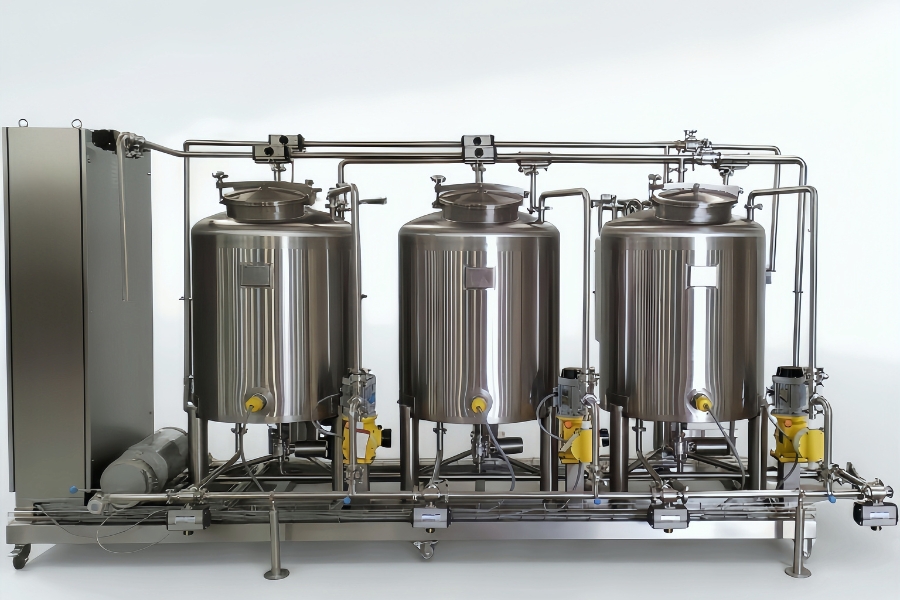
Core Working Principle: Automated, Validatable Cleaning
The Cassman Automatic Clean-In-Place (CIP) System is engineered to automate the sanitation of process equipment, including internal pipelines, vessels, and contact surfaces. The system operates by circulating cleaning solutions of a specific temperature and concentration through the target equipment. It achieves superior cleaning through a combination of:
Physical Scouring: A high-flow circulation pump generates turbulence and mechanical force to dislodge and remove soil.
Chemical Action: Precisely dosed detergents (acid, alkali) and sanitizers chemically break down and dissolve organic and inorganic residues.
Thermal Enhancement: Elevated temperatures are used to accelerate chemical reactions, significantly improving the efficacy of the cleaning agents.
The core of the system is its process automation logic. A central PLC (Programmable Logic Controller) executes pre-programmed cleaning recipes, managing the entire sequence—from solution preparation and heating to circulation, rinsing, and sanitization—without the need for manual intervention. This ensures every clean is repeatable, efficient, and meets stringent hygiene standards.
Modular System Architecture
The Cassman Automatic CIP System is built on a modular skid, integrating core functional modules with a central control system for seamless, automated operation.
| Module Category | Core Components | Primary Function |
| Cleaning Solution Storage Module | Acid Tank, Alkali Tank, Sanitizer Tank, Fresh Water Tank | Securely stores various cleaning media (e.g., Sodium Hydroxide, Nitric Acid, Hypochlorite sanitizer, Purified Water). Tanks are typically equipped with level sensors to prevent shortages and agitators to ensure uniform concentration. |
| Heating & Temperature Control Module | Electric Heating Elements / Steam Heat Exchanger, Temperature Sensors, Modulating Control Valves | Heats cleaning solutions to their optimal working temperature (e.g., alkali wash at 60-80°C for enhanced degreasing). The system continuously monitors and maintains the setpoint temperature to ensure effectiveness and prevent equipment damage. |
| Circulation & Delivery Module | Stainless Steel Centrifugal Pumps (Acid, Alkali, Water), In-line Strainers, Pressure Sensors | - Pumps: Provide the high-pressure, high-volume flow (typically achieving ≥1.5 m/s velocity) required for effective mechanical cleaning.
- Strainers: Protect pumps and prevent dislodged debris from re-entering and blocking the system.
- Pressure Sensors: Monitor line pressure in real-time to prevent over-pressurization and leaks. |
| Control & Monitoring Module | PLC Control Cabinet, HMI Touchscreen, pH Sensor, Conductivity/Concentration Sensor | - PLC: The "brain" of the system, executing pre-set cleaning sequences (e.g., "Alkali Wash 30 min → Rinse 15 min → Acid Wash 20 min...").
- HMI: An intuitive, visual interface for setting parameters, monitoring cleaning progress, and accessing historical data logs.
- Sensors: Provide real-time feedback on critical parameters like pH and concentration, ensuring solutions are within specification and triggering alarms if deviations occur. |
| Auxiliary & Safety Module | Drain Valves, Vent Valves, Safety Relief Valves, Emergency Stop Button | - Drain/Vent Valves: Automatically manage the draining of waste solutions and the venting of air from pipelines.
- Safety Relief Valves: Provide mechanical over-pressure protection for all circuits.
- Emergency Stop: Allows for immediate shutdown of all operations in case of a critical failure, ensuring operator safety. |
Typical 7-Step Cleaning Process for Brewing Equipment
The following is a standard, fully automated cleaning cycle for equipment like fermentation tanks or bright beer tanks, as executed by the Cassman CIP System.
1. Pre-Rinse (5-10 Minutes)
Action: The system circulates ambient-temperature fresh water through the equipment.
Purpose: To flush out loose residual materials such as yeast, fruit pulp, and other easily removable soils, thereby reducing the chemical demand of subsequent steps.
2. Alkaline Wash (20-30 Minutes)
Action: A 1-2% Sodium Hydroxide (Caustic) solution, heated to 60-80°C, is circulated.
Purpose: To saponify fats and break down proteins, hop resins, and other organic soils that adhere to equipment surfaces.
3. Intermediate Rinse (10-15 Minutes)
Action: The system performs a thorough flush with ambient-temperature fresh water.
Purpose: To completely remove the alkaline solution and suspended soils. The rinse continues until the pH sensor in the return line confirms the water has returned to a neutral pH, preventing chemical reactions with the subsequent acid step.
4. Acid Wash (15-20 Minutes)
Action: A 0.5-1% Nitric or Citric Acid solution, heated to 40-60°C, is circulated.
Purpose: To dissolve inorganic scale deposits, primarily mineral salts like calcium oxalate (beerstone) and water scale (calcium carbonate).
5. Final Rinse (10-15 Minutes)
Action: A final, comprehensive rinse with purified or sterile water.
Purpose: To remove all traces of the acid solution, ensuring the equipment is free of any chemical residue and meets food-grade hygiene standards.
6. Sanitization (5-10 Minutes)
Action: The system circulates either hot water (80-85°C) or a chemical sanitizing solution (e.g., peracetic acid, hypochlorite).
Purpose: To perform a terminal microbial kill step, eliminating residual bacteria, yeast, and other microorganisms.
7. Drying (Optional)
Action: The system purges the equipment with sterile compressed air or nitrogen.
Purpose: To remove all remaining moisture, creating an environment that inhibits microbial growth and preparing the vessel for the next production batch.