A craft brewery in central Lyon has moved into steady production following the successful installation and commissioning of two Cassman 2,000 L conical fermentation tanks (CCTs). After just three weeks of on-site work—from placement to first wort—the team reports exceptional temperature stability, faster CIP cycles, and seamless integration with their existing brewhouse controls.
No fanfare, no delays—just reliable hardware that performs as promised.
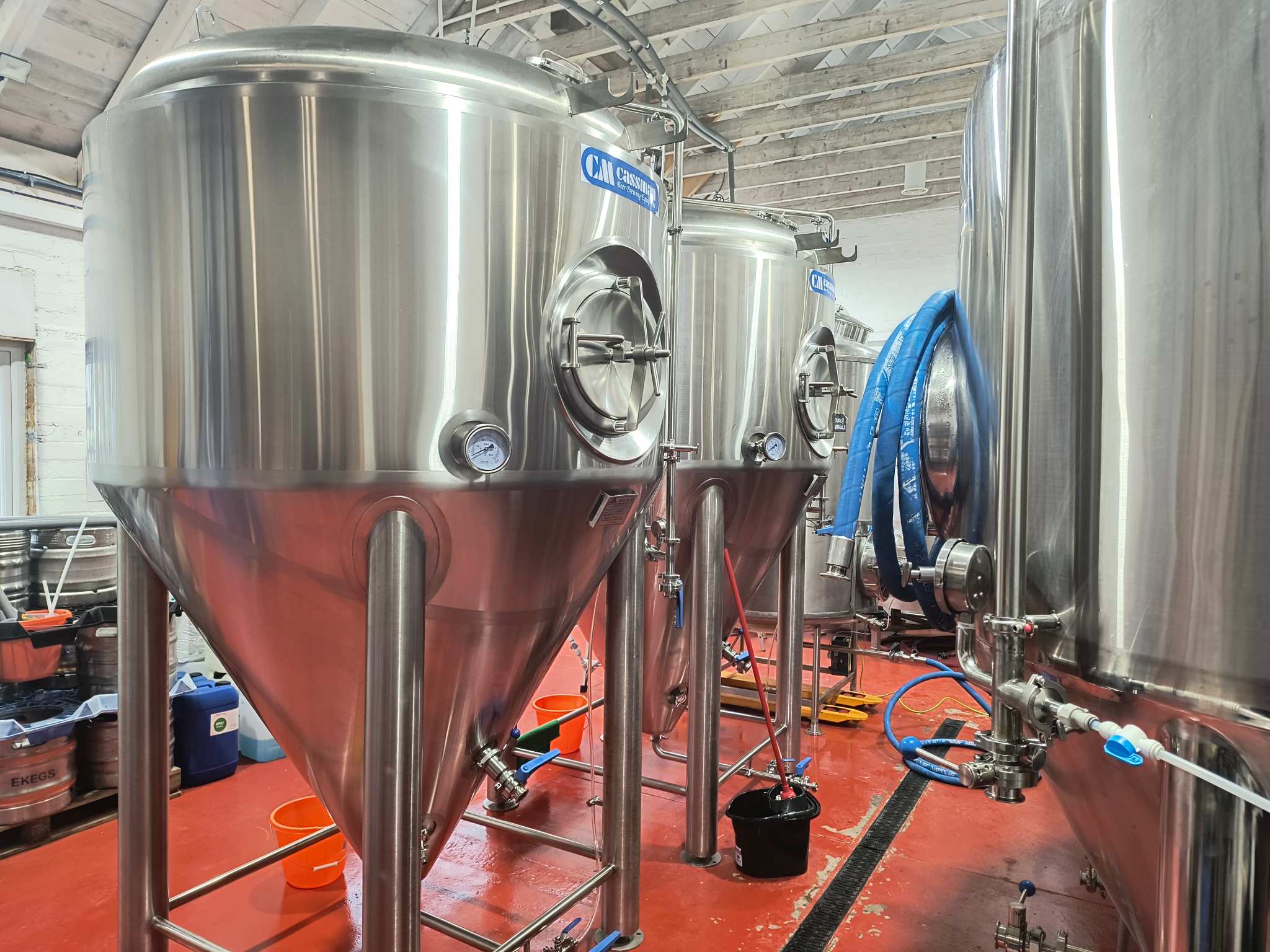
Project Snapshot
Location: Lyon, France (6th arrondissement industrial zone)
Equipment: Two 2,000 L SUS304 conical fermenters, fully jacketed, CIP-ready
Key features:
Dual-zone glycol jackets for precise thermal control
Rotary CIP spray balls with full coverage
Sanitary tri-clamp ports, sight glass, PRV, sampling valve, thermowell
Integrated systems: Glycol manifolds, CO₂/compressed air lines, PLC/SCADA interface for real-time monitoring
Support provided: Remote commissioning, P&IDs, SOPs, and maintenance checklists
Installation & Commissioning: Precision from Day One
The team didn’t cut corners—and neither did we:
Placement: Tanks leveled to ±1 mm tolerance—critical for consistent yeast settling and clean blowdown. Anchor bolts torqued per spec.
Glycol system: Jacket pressure tested to 3 bar; dynamic cooling trials confirmed the tanks hit target fermentation curves (e.g., 18°C → 2°C in <18 hrs for lagers).
Instrumentation: All probes, gauges, and safety valves calibrated on-site. CIP loop validated for spray pattern and return flow—zero blind spots.
First batch protocol: Cold water run → inert gas purge → full CIP cycle → sterile verification → wort fill. No shortcuts.
What the Brewery Noticed—Right Away
“Temperature control is exceptionally stable, and CIP now takes less time and chemicals. We’re more confident reproducing our target flavors.”
— Client, Lyon (name withheld by request)
Their observations align with measurable improvements:
±0.2°C stability during primary fermentation—minimal overshoot or lag compared to older tanks
20–30% shorter CIP cycles, with reduced caustic and hot water consumption
Hygienic design wins: orbital welds, no dead legs, easy-to-clean sampling ports, and a responsive PRV that passed local safety checks
Operator-friendly layout: Logical valve grouping, clear open/closed indicators, and intuitive HMI mapping cut changeover time between batches
Most importantly: flavor consistency has tightened. Repeated brews of their flagship IPA now show less batch-to-batch variance in esters and bitterness—thanks to lower oxygen pickup and better contamination control.
Real Performance Across Beer Styles
High-krausen ales: Ample headspace + stable pressure control = fewer blow-off incidents
Lagers: Zoned jackets maintain uniform cooling during long, cold ferments—critical for clean Pilsner profiles
Dry hopping: Top manway and tri-clamp ports make hop additions fast, safe, and closed-system
Compliance & Documentation: Ready for Inspection
All required paperwork was delivered ahead of commissioning:
Material certs (SUS304), pressure test reports, weld logs
FAT/QC records and CE compliance documentation
Food-contact compliance files for French health and insurance audits
Operations & Maintenance: Built to Last
The client received a practical maintenance guide covering:
Recommended CIP parameters (alkali/acid temps, rinse durations)
Glycol quality checks and annual jacket integrity tests
Spare-part schedules for seals, PRVs, and diaphragm valves
What’s Next for the Brewery?
Monitor fermentation curves and glycol loads over the next three production batches; fine-tune PID settings for even tighter control
Evaluate adding a third 2,000 L FV or a brite beer tank (BBT) to improve packaging throughput
Enroll in Cassman’s quarterly remote health checks—including energy use and process optimization tips
Why This Matters
This isn’t a “turnkey fantasy.” It’s a real brewery in Lyon—working with limited space, tight margins, and high sensory standards—now brewing with more confidence, consistency, and control.
At Cassman, we design fermentation tanks not just to meet specs, but to perform reliably in daily production, batch after batch.
Planning Your Fermentation Upgrade?
Tell us:
Target batch size (L)
Monthly output goal
Heating/cooling method (glycol, steam, etc.)
Voltage/frequency (e.g., 400V/50Hz for EU)
Floor plan (even a sketch helps)
We’ll send a preliminary configuration, utility checklist, and budget estimate within 48 hours.
Explore our solutions:
→ Fermentation & Brite Tanks (100–3000 L)
→ CIP & Sanitary Systems
→ Glycol Cooling Packages
Contact: inquiry@cassmanbrew.com
Website: www.cassmanmachine.com
Cassman — Where repeatability starts in the tank.


